

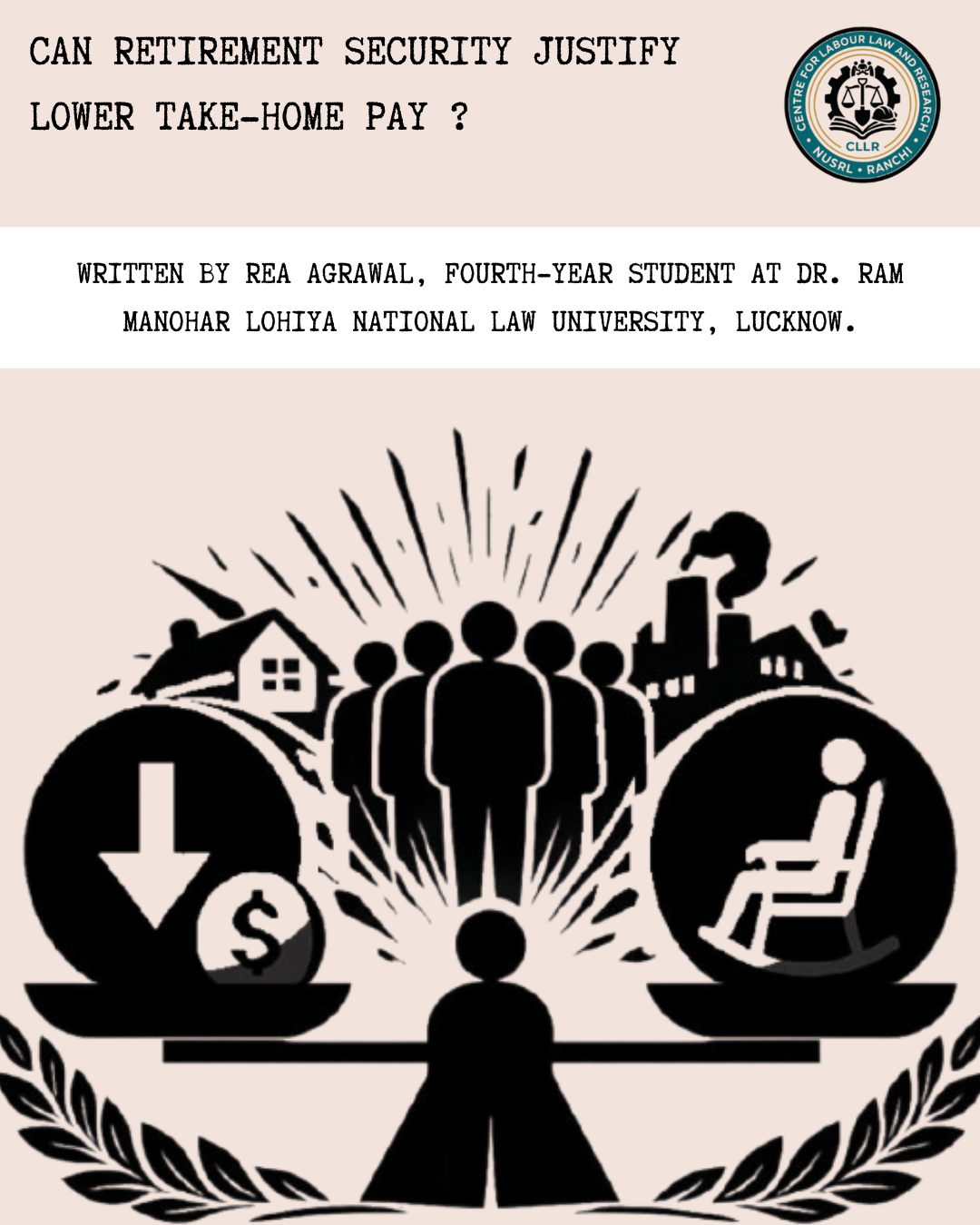
Written by Rea Agrawal, a fourth year law student at Dr. Ram Manohar Lohiya National Law University, Lucknow.
The newly introduced Code on Wages, 2019 comes around as a breath of fresh air which promises to unshackles us from the arduous chains of navigating 48 different, diverse legislations of Labour Law by consolidating them into one. The code seeks to consolidate and simplify four major laws governing wages: the Payment of Wages Act, 1936; the Minimum Wages Act, 1948; the Payment of Bonus Act, 1965; and the Equal Remuneration Act, 1976.
A pertinent issue that drove the Legislature to pass the Code was the ambiguous definition of “wages” that existed across the legislations. Section 2(y) is arguably the most important provision of the entire Code, upon which the understanding of the rest of the Code hinges. The section gives an adept definition of “wages” and defines wages as any renumeration expressed in terms of money or capable of being so expressed that would be given to a person employed on fulfilment of his employment conditions. Importantly, the term wages’ scope has now been confined to include only basic pay, dearness allowance and retaining allowance. Further, the Code has mandated the Basic pay to be at-least 50% of the CTC– Cost to Company. CTC is the total amount a company spends on an employee for their services. This includes salary, benefits, allowances, bonuses, contributions to the provident fund, and other contributions.
By doing so, the Legislature attempts to cut through the sordid attempts of the employers who used to cut corners on statutory benefits to employees by making the basic pay of a person- which is used for calculation of benefits such as gratuity, provident fund, leave encashment, retirement benefits & salary increments– only 30% of CTC and loading the rest into various allowances to reduce their statutory contribution burden. This reduction in statutory contribution by the employers induced a constant social security struggle for the employees.
-
- Psychological Perspective/ reward system of humans
The Labour Codes, though nobel in their pursuit, have committed a grave mistake by not accounting for the psyche of the very stakeholders that it purports to safeguard- the employees.
The 50% rule implies that the allocated amount for allowances would be significantly reduced and the contribution to the provident fund through the basic pay increases. This means that the employees who earlier received more take-home salary through encashing various benefits & through basic pay being set at a lower percentage by the employer implying less PF contribution, will now receive a lowered take-home salary due to increased PF contributions. Though the intent is to protect employees from the employer’s languorous bypass of PF contributions is well-founded, the legislature failed to take into account that the contribution towards an abstract, unreachable PF account could & would have significant effects towards an employees’ work productivity.
The following discussion on human psyche is an exhibit of complex behavioral patterns that govern the human perception of rewards, in light of which the reduction in instant rewards would be perceived more as a punishment than as an investment into the future by the employees.
-
- Effect on dopamine
In a 2001 study by the National Institute on Alcohol Abuse and Alcoholism, eight physically and psychiatrically healthy volunteers were led to believe that on their successful performance of a task they were to receive a monetary reward and participants reported experiencing more happiness when $1.00 and $5.00 cues appeared, in comparison to the $0.00 cues. When an employee receives their take-home salary, the Ventral Striatum & NAcc triggers a dopamine release.
To further understand the effects of reward on a human’s psyche, one may look at Thorndike’s puzzle box experiment. The experiment led to the formulation of the Law of Effect which states that “any behaviour that is followed by pleasant consequences is likely to be repeated”. In this case, the pleasant consequence for employees can be considered to be their salary. It is the stimulus which makes them inclined to repeat the behaviour of working. Based on the experiment, one would be inclined to assume that an employee would feel more assured considering that the threshold of his basic pay has been increased and fixed at 50% now. However, this assumption would prove to be incorrect due to the effect of lapse of time in receiving the reward. A higher basic pay implies higher contribution from both the employees and employer towards PF & Gratuity-accruing far off in the future- while resulting in a decrease in immediate take-home salary of the employee.
While the Thorndike experiment is helpful in understanding what drives a person to work to attain a reward in the form of salary, the Wolfurd Schultz experiment is key to understanding how delay in rewards affect a person’s task performing abilities. Time intervals are not directly perceived by specific receptors and instead, must be constructed by the brain. This accuracy of estimating time intervals decays proportionally with delay. The Wolfurd experiment investigated how midbrain dopamine neurons in Macaca fascicularis monkeys react to rewards. Monkeys were trained on three consecutive tasks of increasing complexity: a spatial choice task, an instructed spatial task, and a spatial delayed response task by the experimenters shining an instruction light and a trigger light. In all versions of the task, correct lever presses resulted in a drop of apple juice delivered after a 500 msec delay. What is relevant to us is the observation of dopamine neurons in error trials. In error trials, where a reward was expected but not delivered due to a wrong lever touch, the dopamine neurons showed a reproducible depression of activity at the exact moment the reward was typically given. This indicates that dopamine neurons do not simply react to the physical juice and decrease their firing when an expected reward fails to arrive.
To put this into the context of employees in the framework of the Code on wages, the failure to receive an expected reward- higher amount of take-home salary decreases the response of the dopamine neurons. This decrease disrupts the brain’s ability to process motivation, learning, and the execution of complex cognitive tasks.
-
- Temporal Discounting
Humans are inclined towards preferring immediate, instantaneous gratification over delayed gratification even if the delayed reward is larger. The perception of value of a reward with respect to delay in receiving it may be represented as V= A / (1 + kD).
V= Perceived value of the award
A= Actual amount, which in this case would be the Provident Fund corpus
D= Delay relative to the present time, which will be the years until retirement in this case
k= Discount rate, which is a variable that accounts for impatience in an individual
Since D for a young employee is massive, the perceived value (V) of the provident fund often registers as near zero in the brain’s immediate reward centers compared to the immediate loss with respect to each month’s take-home pay.
Growing concerns and suggestions
A study has shown the effect of wages on productivity, though the study did not examine PF accruement as an indicator.
Importantly, the 50% rule fails to account for a significant chunk of the employee stakeholder that work in hazardous conditions. For many, the medical allowance serves as an incentive to engage in hazardous duties or works that are likely to have a debilitating effect on health over a period of time. These may include sweepers engaged in cleaning of underground drains or workers in infectious diseases hospital. The loss of such medical allowance would lead to their already perilous job being more arduous without the greater hope for coverage in case of any untoward happening to the worker.
Since the ultimate goal of the framework is to benefit the employees, a few measures may be undertaken to ensure that the benefit registers in the employee’s psyche. Providing employees with real-time, visual compounding trackers annually can help the prefrontal cortex see the reward. Comparing the PF contribution to its earlier despondent rates can help restore employee motivation. Employing models like the Save More Tomorrow model wherein people commit in advance to allocating a portion of their future salary increases toward retirement savings shows average saving rates increased.
The above models clearly show that the Code has forsaken considering human fallibility in light of far-sightedness. The Code on Wages, 2019, aims to consolidate labour laws and prevent employers from reducing statutory benefits by mandating basic pay at 50% of CTC. However, this shift reduces immediate take-home pay, triggering temporal discounting where employees value current rewards over distant, abstract future security.
Keeping these well-established psychological phenomena inflicting human psyche in mind, is the decision a well-reasoned and thought-out decision or has the legislature gone too far ahead in their efforts to curb employer perfidy?
Caveat: The views, analyses, and information presented in this article are provided in good faith and for general informational purposes only. No representation or warranty, express or implied, is made regarding the accuracy, adequacy, validity, reliability, or completeness of the information. Readers should conduct their own research and seek professional guidance where appropriate. Neither the author nor the publisher shall be held responsible for any loss, liability, or consequence arising from reliance on this content.
Leave a Reply