

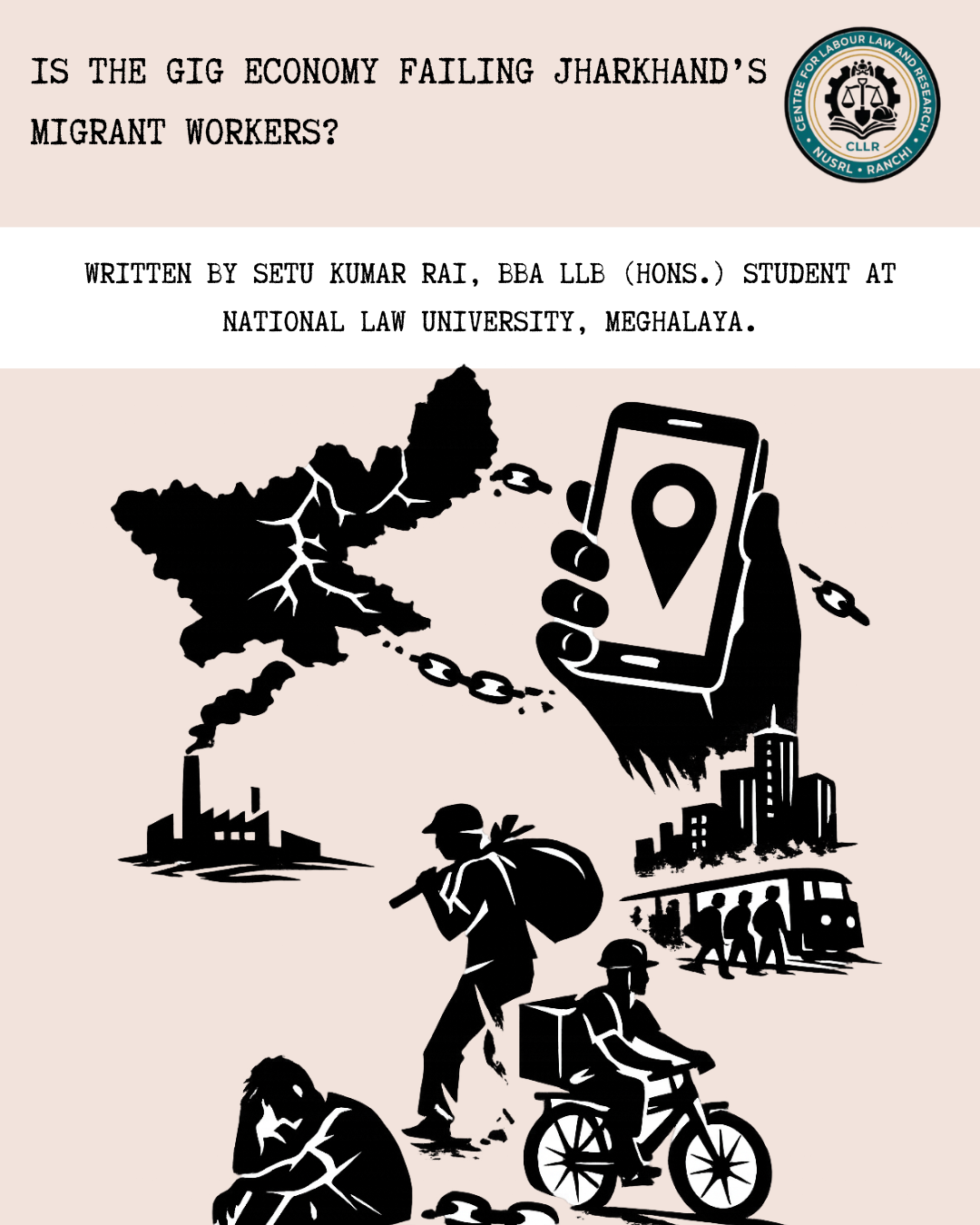
Written by Setu Kumar Rai, BBA LLB(Hons.) student at National Law University, Meghalaya.
Each year, an influx of workers leave Jharkhand, India’s most natural-resource-rich but economically distressed State in search for jobs and opportunities. The majority of them relocate to large cities such as Bengaluru, New Delhi, Hyderabad and Pune, where some find employment as delivery riders, taxi drivers, domestic support and others who provide logistics to firms via online platforms. They are, in the parlance of the new economy, ‘gig workers’. Yet in law, they remain a ghost neither employee nor independent contractor, their rights perpetually deferred to a regulatory tomorrow that never arrives.
This blog focuses on the vulnerability of the migrant gig worker demographic in Jharkhand, a demographic that is doubly disadvantaged due to the lack of institutional infrastructure in their state of origin and the lack of recognition of their rights by the jurisdiction in which they work as deserving of protection. Additionally, the blog examines the recently established provisions of the Code on Social Security, 2020, which, for the first time, provides institutional recognition of gig and platform workers. However, the legal provisions that establish recognition are essentially meaningless in practice. The blog highlights the failures of interstate coordination of welfare mechanisms and proposes specific legal and policy solutions.
Jharkhand as a Labour Export State: The Migration Imperative
Jharkhand has a unique, inverted relationship with the economy of India because it contains about 40% of the nation’s natural mineral resources and is one of the worst states for human development according to humanity’s human development index. In fact, there are many states in India that have high levels of wealth but have low levels of human development; but these states are not as severely affected by levels of distress migration as Jharkhand because distress migration from Jharkhand is structural. Traditional livelihoods are failing, agricultural infrastructure is not adequate to support those who still remain in the agricultural economy, people who are in agriculture and have been disposed of from their agricultural land by extractive industry, and Scheduled Tribe communities remain systematically excluded from being employed in the formal economy, forcing people in Jharkhand to migrate simply to survive.
What is particularly significant for the purposes of this blog is the nature of employment that awaits these migrants at their destination. The platform economy is steadily taking over the informal economy. Delivery of food, ride sharing, e-commerce logistics and domestic services has become platform based, creating millions of entry-level jobs that draw workers with limited skills or documentation. Workers from Jharkhand, many of whom do not have formal educational backgrounds and lack urban social networks, are heavily represented in this segment of the workforce.
Who Are the Migrant Gig Workers from Jharkhand?
The migrant gig worker from Jharkhand defies the assumptions embedded in most gig economy discourse. Policy discussions typically centre on urban, educated, and semi-skilled individuals who choose platform work for its flexibility. The Jharkhand migrant, by contrast, enters the gig economy not by preference but through necessity often with minimal digital literacy, without family support networks in the destination city, and without any understanding of the contractual frameworks that govern their relationship with platform aggregators.
These workers are also invisible to the existing regulatory apparatus. The Inter-State Migrant Workmen (Regulation of Employment and Conditions of Service) Act, 1979 the only dedicated law for interstate migrants applies to workers recruited through contractors and deployed to establishments. It was designed for the brick kiln or construction worker, not for the Zomato delivery partner who registered himself on an app. The definitional architecture of the old law simply cannot accommodate the new worker.
The result is a worker who is doubly excluded not an ‘inter-state migrant workman’ under the 1979 Act, and not a ‘worker’ under conventional labour legislation. They occupy a legal lacuna that the four Labour Codes were supposed to address, but have, as argued below, only partially and inadequately filled.
The Legal Vacuum: What the Labour Codes Say and Do Not Say
The Code on Social Security, 2020 represents the most significant legislative acknowledgement of gig and platform workers in Indian law. Both gig workers and platform workers are contained in the Code’s Sections 113 and 114; they require both the Central Government and the State Government(s) to provide welfare schemes for these respective classes of workers. This is a historic moment in that it is the first time that a piece of legislation has identified and specifically referenced these workers, after acknowledging that they exist.
However, the acknowledgement falls dramatically short of protection. The Code doesn’t provide gig workers with employment status. Therefore, it does not provide gig workers with minimum wages, paid leave, or rights to organize. The Code does not contain a grievance redressal mechanism, nor does it protect against deactivation of accounts (the equivalent of termination of a contract of employment with a company) at the discretion of the platform, nor does it provide gig workers access to any social security scheme that formal employees receive under the Employees’ Provident Fund and/or Employees’ State Insurance Corporation. The welfare schemes under s 114 remain aspirational dependent on government initiative, subject to fiscal constraints, and as yet unnotified in most states.
For the Jharkhand migrant gig worker, this gap is particularly acute. Social security schemes, even where notified, are state-specific. A worker registered in Jharkhand who works in Karnataka is unlikely to access schemes in either state. The Code makes no provision for portability of benefits or cross-state recognition of registration an omission that effectively excludes the very population most in need of protection.
Inter-State Welfare Coordination Failures
The COVID-19 pandemic has clearly shown how poorly we coordinated our systems. In March of 2020, when all the platforms shut down, Gig workers were left stranded in large cities without income, with no employer to rely upon for assistance. Many of these workers were Migrants from Jharkhand, Bihar and Orissa states. Since they were working as “invisible” workers, they became “visible” to the nation’s consciousness for only a brief time, and then were quickly forgotten again afterwards.
The structural problem is that Indian labour law remains organised around the state as the primary administrative unit, while migration is by definition a cross-state phenomenon. Source states like Jharkhand have limited leverage over working conditions in destination states, and destination states have little incentive to invest in the welfare of workers who will eventually return home. The migrant gig worker falls into this institutional gap, claimed by neither state with any seriousness.
The State Migration Policy of Jharkhand 2016 was intended to lay out a framework to support and protect the migrants being sent out from the state in many different ways (including registration as well as skill training and registration of complaints). Although it had good intentions for these things, there were actually very few of them implemented due to the fact that most of them were created before gig economy began. Also, the policy did not take into account the unique vulnerabilities faced by people who are working for gig/online platforms (i.e., vulnerable workers) and has no provisions regarding how algorithmically wrapped in the management structure might affect platform based workers.
Recommendations: Towards a Rights-Based Framework
First, the Code on Social Security must be amended to provide for portability of gig worker registration and benefits across states. A centralised digital registry akin to the ‘One Nation One Ration Card’ model should enable a gig worker registered in Jharkhand to access welfare benefits in the state where they actually work. This requires political will and inter-governmental coordination through the Inter-State Council.
Second, Jharkhand should follow the precedent set by Rajasthan’s Platform Based Gig Workers (Registration and Welfare) Act, 2023 currently the most progressive state-level legislation on the subject and enact its own gig worker welfare legislation with specific provisions for migrant gig workers, including a welfare fund financed by a levy on platform transactions.
Third, the question of employment classification must be confronted directly. The binary of ’employee’ versus ‘independent contractor’ is a fiction in the platform economy courts in the United Kingdom, France, and California have recognized that platform workers are a sui generis category deserving of intermediate rights. Indian courts and the legislature must similarly evolve a third category, perhaps a ‘dependent contractor’ or ‘platform worker’ with defined minimum entitlements.
Fourth, algorithmic accountability must be legally mandated. Gig workers are governed not by managers but by algorithms opaque systems that determine their ratings, earnings, and ultimately their continued access to the platform. Any meaningful labour protection framework must require platforms to disclose the criteria and logic of algorithmic management and provide workers with a right to explanation and appeal.
A person from Jharkhand who works as a migrant on a gig platform in India has several types of vulnerabilities (migrant status, lack of formal employment, low-wage worker) that all come together to make them vulnerable. They are often acknowledged by law but not given any access to rights that would provide them with protection. The Social Security Code passed in 2020 opened up new avenues for this type of worker to be protected, and it is now up to the legislators, Courts, and Policy Makers to take action to assure these workers have an opportunity to work and earn a living wage. History shows that all labour laws are created in response to exploitative forms of labour. The industrial revolution produced factory legislation; the rise of subcontracting produced contract labour regulation. The gig economy and its particular manifestation in the lives of distress migrants from states like Jharkhand demands a similar legislative response. The question is not whether this reform will come, but whether it will come before another generation of workers is lost to the shadows.
Caveat: The views, analyses, and information presented in this article are provided in good faith and for general informational purposes only. No representation or warranty, express or implied, is made regarding the accuracy, adequacy, validity, reliability, or completeness of the information. Readers should conduct their own research and seek professional guidance where appropriate. Neither the author nor the publisher shall be held responsible for any loss, liability, or consequence arising from reliance on this content.
Leave a Reply