

Written by Srikrishna Laudia is pursuing B.A. LL.B. at Hidayatullah National Law University (HNLU), Raipur.
Abstract
On 12 June 2026, The International labour organisation (ILO) adopted Convention No. 193 on Decent Work in platform Economy, the world’s first binding international standards on algorithmic management. The convention mandates transparency in determining wages, human review in deactivation, and safeguards against automated termination. India, a founding member of ILO, faces a foundational query, Does the four newly implemented Labour Codes meet the minimum threshold this global consensus demands. This article argues they do not. While the Social Security code, 2020 recognising gig workers, it leaves the algorithmic system that monitors the employments work. Platforms operate through opaque wages, real-time surveillance, and automated unfair de-activation. Against the backdrop this article proposes four reforms: mandatory algorithmic transparency obligations, a human review before deactivation, a rebuttable presumption of employment for algorithmically controlled workers, and expanded welfare board jurisdiction to adjudicate platform-specific harms. For 7.7 million gig workers, recognition without accountability is not protection.
INTRODUCTION
On June 12, 2026, the International Labour Organization (ILO) at the 114th session of the International Labour conference adopted the world’s first international rules specifically dealing with algorithmic management on the online platforms.
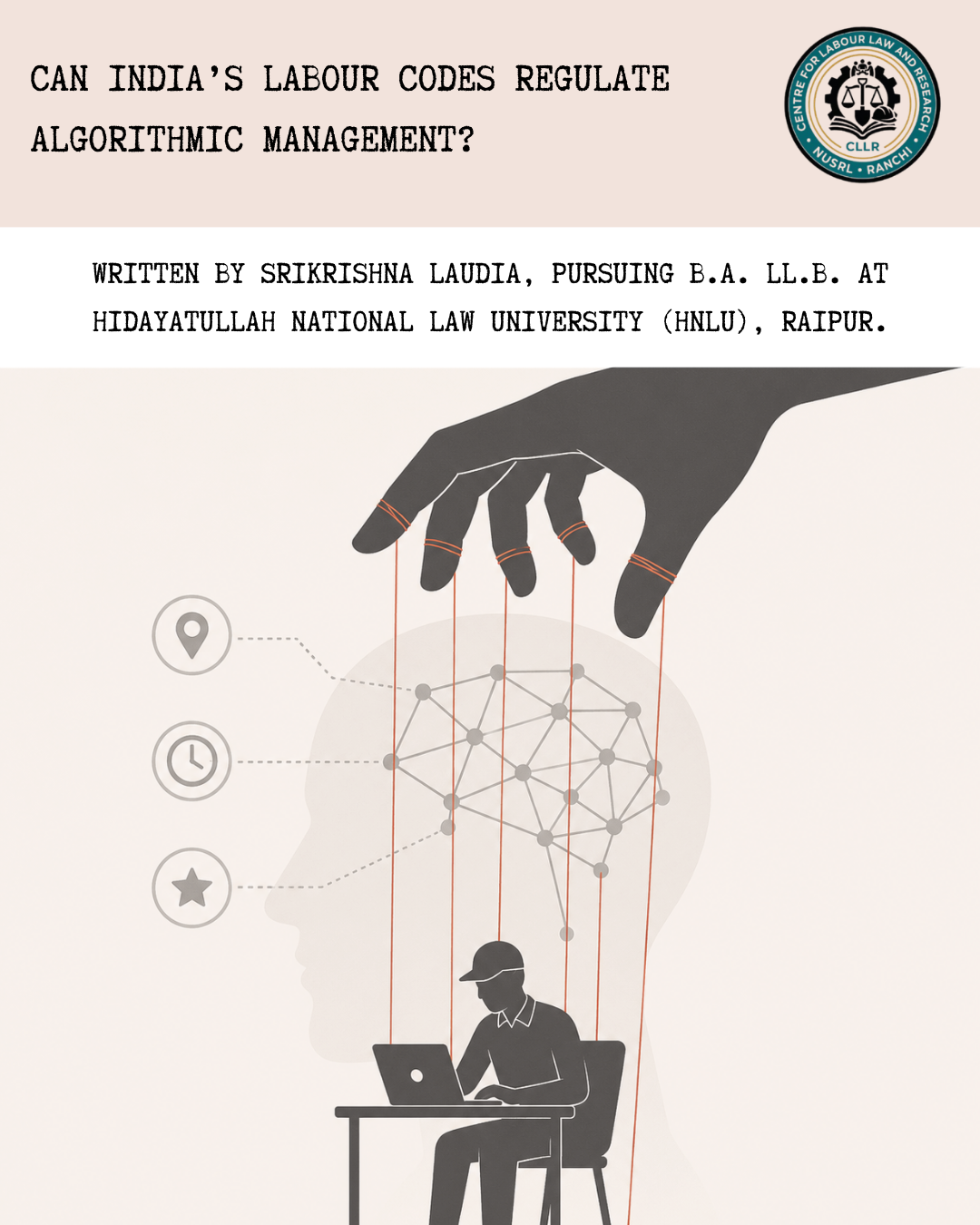
In today’s modern economy, human managers have disappeared, replaced by algorithmic supervision. Online platforms such as Blinkit, Zomato, Swiggy, and Rapido implement unaccountable algorithms to evaluate performance, assign tasks, and terminate platform workers without human intervention. This invisible manager acts as a supervisor and makes major employment decisions through data-driven systems that workers cannot question.
Today, algorithms control nearly every area of gig work in India, location tracking, task allocation, and termination based on customer ratings. A 2025 study indicated that companies use algorithms to control payments and work assignments, leaving gig workers without the right to appeal or challenge unfair decisions. On 21 November 2025, for the first time, India implemented four new labour codes replacing twenty-nine labour laws defining gig and platform work. However, there is still a huge gap, leaving 7.7 million workers without protection. Workers face unsafe conditions and no solution when deactivated. This article argues that recognising gig workers in statute is nothing as long as the algorithm that controls them remains entirely unaccountable.
Recognition without protection
It is no longer a theoretical concern that Indian gig workers are under the control of algorithm. But a practical reality embedded in the platforms that define the boundaries of India’s platform economy. The NITI Aayog has estimated the gig workforce to reach 23.5 million by 2029-30, expanding across delivery platforms. Across all these platforms, algorithms play a vital role. The Social Security Code, 2020, recognised gig workers. The law also provides welfare schemes for these workers. Specifically, Sections 2(35) and 2(61) define “gig workers” and “platform workers” and recognise these categories under Indian law.
However, recognising the worker is not the same as regulating the system that controls them and on that, the code is silent. No platform is required to explain how decisions are made. Most of the platforms classify them as contract workers. By excluding gig workers from the definition of ‘workmen’ under the Industrial Disputes Act, 1947, platforms ensure that the right against wrongful terminationis unavailable to those who need it most. the worker is recognised by the law, but the algorithm remains unregulated.
THE ALGORITHM PARADOX
The platforms recognise gig workers as separate class of workers so as to avoid traditional employer obligations. They subject the workers to a degree of digital micromanagement that is far beyond the supervision of humans. This fundamental paradox is the core of the current legal standoff. Algorithmic control operates through three interlocking mechanisms:
Firstly, the illusion of autonomy vs. real-time surveillance. Platforms often market the gig work as the expression of flexibility, offering liberty to choose the work hours. This autonomy is an illusion. The algorithm exercises absolute, real-time control through surveillance using continuous GPS Tracking, enforcing rates. The worker cannot deviate from the path calculated by the algorithm without facing penalties, lowering visibility, or diminishing the access to high-paying slots. Therefore, the worker does not control the platform; the platform flexibly controls the worker. This constitutes a form of continuous surveillance and monitoring to which no worker has meaningfully consented. The Digital Personal Data Protection Act, 2023, was designed to address but has not yet been operationalised, leaving the workers intimate data entirely at the platform’s disposal.
Secondly, opaque wages and information asymmetry. In a consistent employment relationship, wages are determined by contract. “Compensation is a fluctuating black box”. Pay structures are continuously fluctuating based on variables such as surge pricing and secret performance measures and are driven by dynamic pricing algorithms. The platform holds clear data of market demand, while the worker has no idea and operates in complete darkness, unable to predict their daily wages.
Thirdly, and most destructively, algorithmic de-activation. In traditional labour frameworks, the termination of a livelihood requires evaluation by human, a paper trail, and an opportunity for the employee to appeal the decision. However, under an invisible manager, termination is outsourced to an automated system known as deactivation. A temporary system glitch, unverified poor customer ratings, leads to an automated lockout from the platform.
Further, these systems lack a human review mechanism; workers are stripped of their jobs overnight with no viable avenue to dispute their termination. This is clearly a violation of the principle audi alteram partem; the right to be heard before an adverse decision is made is the foundation of natural justice that has been consistently upheld since A.K. Kraipak v. Union of India, and which cannot be permitted to evaporate simply because the decision maker is an algorithm.
PROTECTED ON PAPER, EXPOSED IN PRACTICE
The deficiencies that portray India’s legislation concerning algorithmic control are not mere oversights but rather deliberate. Of the four labour codes introduced in November 2025, only the social security code engages with gig workers, and even this provision is limited to welfare registration, leaving algorithmic control and surveillance largely unregulated.
First, the biggest foundational failure is the complete absence of an algorithmic transparency obligation. None of the four codes mandates platforms to disclose the criteria used by their automated systems to restrict, evaluate, or terminate workers. This clearly amounts to denial of the principle of audi alteram partem.
Secondly, structural failure is the acceptance of independent-contractor fiction. While the code on social security, 2020, presents a limited welfare framework for gig workers, it does not challenge the formal categorisation as self-employed persons. This perpetuates their exclusion from core labour protections, notwithstanding the widespread managerial control exercised by platforms. Such control closely aligns with the tests of employment articulated by the Supreme Court in the Silver Jubilee Tailoring case, making the continued reliance on contractor status is increasingly difficult to justify.
Third, the welfare boards set up under the code carry jurisdiction over maternity and health, not over unfair deactivation or opaque wages, leaving workers without any right to approach when the harm occurs. The DPDP Act, 2023, meanwhile, is only partly in force so far leaving workers location and biometric data entirely unregulated in practice.
Further, exclusion from the Trade Unions Act, 1926, makes collective bargaining structurally impossible, while state-level labour bodies, which are designed for factories, are authorised to inspect registers and physical premises – which possess neither the mandate nor the technical capacity to inspect or audit nationally operating algorithmic systems. None of this is accidental. Recognition without accountability is not protection; it is at worst a replacement for the substantive reform that platform workers have long been owed.
Toward algorithm accountability
The urgency of reform has been sharply highlighted by the recent development at global level. In June 2026, the International Labour Organisation(ILO) adopted Convention No.193 – the Decent work in the Platform economy convention, 2026,first binding global standards specifically addressing algorithm management, requiring accountability regarding the decisions affecting wages, allocation, and termination, and mandating safeguards against unjustified deactivation. India, a founding member of ILO and a signatory to its foundational conventions, is not merely behind the EU in this area. It is behind a framework it has itself endorsed at the international level. The question here is no longer whether reform is necessary, It is, how much longer the law can delay confrontation in which 7.7 million workers are already living through. The framework must operate on four levels:
Firstly, and most immediately, the social security code, 2020 must be amended to impose a mandatory algorithmic transparency obligations mandating platforms to disclose, in accessible terms, wage determination, evaluation and deactivation.
Alongside this, workers must be granted a statutory right to seek reasons for automated decisions and to access a mechanism for contesting them. This is not a new demand. Regardless of whether the decision is made by algorithm or human, it is the very minimum required by the concept of audi alteram partem for any system that has the ability to determine someone’s livelihood.
Secondly, no worker should be deactivated or financially penalized by an algorithm without mandatory human review. A codified human-in-the-loop requirement would ensure that the most consequential decisions in a gig workers life, The decision that determine whether they work tomorrow are reviewed by an accountable person before they take effect. The unaccountability or invisibility of the decision maker cannot be permitted to become a shield against obligations of the natural justice.
Thirdly, India must enact a rebuttable presumption of employment for workers who satisfy the established criteria, where the platform sets the price, monitors performance in real time, controls access to work, and exercises the power of termination. This would shift the burden of proof to platforms to show independence, rather than requiring the worker to prove subordination against a drafted agreement. The EU Platform work directive, 2024 has already operationalised this model. India need not construct the architecture from scratch. It only needs to adopt a framework that has already survived democratic scrutiny and legal challenge in a comparable jurisdiction.
Further, the welfare boards established under the Social Security Code should be granted expanded jurisdiction to adjudicate disputes arising specifically from algorithmic deactivation and opaque wages, with time bound resolution. The welfare board which cannot address the harms platform workers actually suffer is not a safeguard, it is an administrative formality that substitutes the appearance of protection for its substance.
Taken together, these four proposals do not ask the law to choose between innovation and rights. They ask only that the law recognise that efficiency in technology is not a justification for the erasure of the worker it governs.
CONCLUSION
The invisible manager has drastically changed the labour relations, it was permitted to scale by a legal system that chose not to see it. For Indians employed in the gig economy where their Payment, Movement and Employment are completely in the hands of algorithm that they can neither question nor challenge, this is no abstraction. The ILO Conference demands algorithmic transparency, human review, and dismantling of the legal doctrines that strip platform workers of protection.
On June 12, 2026, The ILO by a vote of 406 to 8 signalled that the global consensus has shifted. ILO Convention No.193 demands for human review and transparency in deactivations. India helped to build this consensus. The Social Security Code, 2020 recognises the gig worker, but not the algorithm that governs them. Until the protections are introduced, recognition alone is not progress. And for around seven million workers, appearances are not enough.
Caveat: The views, analyses, and information presented in this article are provided in good faith and for general informational purposes only. No representation or warranty, express or implied, is made regarding the accuracy, adequacy, validity, reliability, or completeness of the information. Readers should conduct their own research and seek professional guidance where appropriate. Neither the author nor the publisher shall be held responsible for any loss, liability, or consequence arising from reliance on this content.
Leave a Reply