

Written by Devansh Awasthi is pursuing B.A. LL.B. (Hons.) at Dr. Ram Manohar Lohiya National Law University, Lucknow
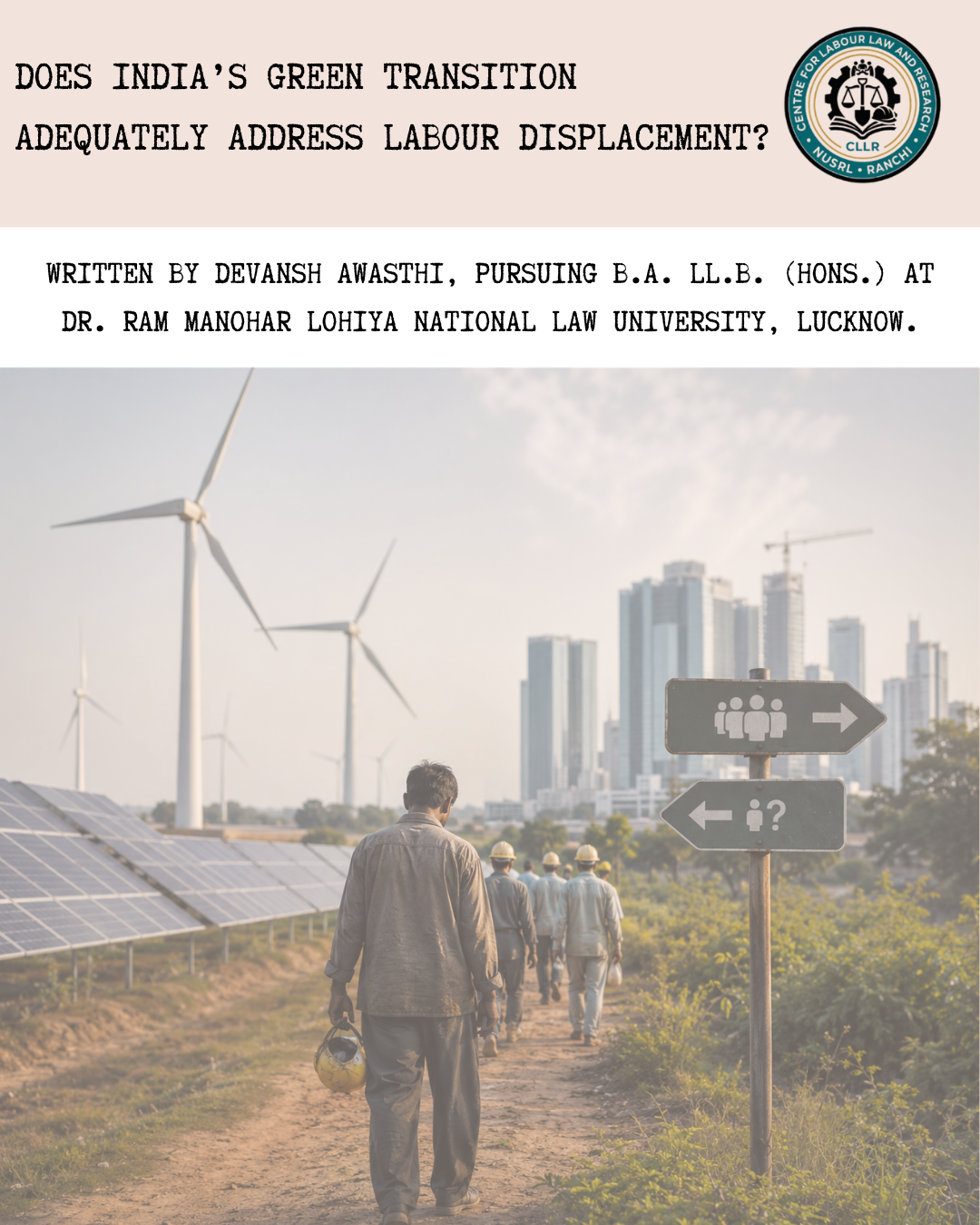
The Green Transition in India is usually discussed in terms of renewable energy, decarbonisation, compliance with ESG standards and net zero targets. Workers are generally absent from this discussion. However, for states like Jharkhand which are dependent on coal, the shift from fossil fuels is about more than the environment, it is about the workforce.
The coal mine is a site of extraction and a source of livelihood. The surrounding area is home to a complex economy of workers including employees, contractors, transporters, loaders, security personnel, informal vendors, repair workers and families that rely on the income created by the mine. When a mine becomes unprofitable or is permanently closed, the issue of how to restore the land or reduce emissions is only one aspect of the situation. The primary consideration is how to support displaced workers who will no longer have a job because of the mine closure.
This is currently a gap in the framework for India’s green transition. Current environmental policies deal with closure, reclamation and sustainability. Current labour legislation deal with retrenchments, compensations and social security; but neither effectively addresses the longer-term need for the rehabilitation of workers and their communities as a result of the closure of mines. A transition that reduces carbon emissions but abandons workers cannot be deemed to be equitable.
The Basis of an Equitable Transition
The basis for an equitable transition is the understanding that environmental reform will not be equitable if it results in economic instability for workers.To achieve a more sustainable and cleaner economy, we will need to ensure that decent work, social protection, reskilling, income support and meaningful participation from affected communities accompanies this transition.
This is particularly true for India; therefore, the coal economy of India is real and not just an abstraction of industry. In many parts of India, coal is an integral part of public finance, employment, transportation networks, small businesses, and even household income. For instance, Jharkhand is one such state with a large production of coal. Jharkhand has a difficult policy decision to make around how to transition away from coal. If India were to suddenly or poorly plan their transition away from coal, it could exacerbate unemployment and regional disparities. On the other hand, if India were to delay this transition indefinitely, it will cause continued environmental problems and undermine India’s commitments to combatting climate change.
The transition from a coal-centered economy to a new way of doing business is not to fight it. The solution is to establish the legal responsibility for the transition.
Mine Closure and the Invisible Worker
Mine closure is often viewed as a technical issue. Regulatory discussions around sites usually focus on the mine’s environmental and safety management, land rehabilitation/restoration, and meeting the requirements of the mining approvals. Although these issues are crucial, they are not taking into account all of the social impacts of mine closure.
The visible workers of a coal mine are formal (permanent) employees of the mine. Formal employees are only part of the mining workforce. A significant amount of mining-related workers are independent contractors or informal workers. These workers contribute significantly to the success of the mine; however, their employment status does not offer the same protections or rights as formal employees. Even though the work they do is critical to the operation of the mine, the fact that they do not appear on a permanent employee register, and have little or no legal recognition of their employment relationship creates a problem for mining companies.
This distinction will be incredibly important when the mine closes.Formal employees typically qualify for financial compensation, pension plans, and job security through redeployment plans offered by their employers. In contrast, many workers (those without formal employment contracts) will often lose their jobs but will not receive much (if any) assistance during their transition from work to unemployment. This is particularly true for miners who lose their jobs once mining operations cease.
Workers who reside in areas surrounding coal mines can be collectively and locally impacted by losing their jobs. Many service businesses (tea shops, repair shops, transportation) rely on the income of coal miners, which often leads to unemployment when a coal mine is closed. Additionally, closures of coal mines result in significant economic disruptions in an area.
How Existing Laws in India Fall Short of Addressing This Issue
India’s employment laws do not offer adequate support for addressing the employment issues resulting from the closure of coal mines. The Industrial Relations Code of 2020 governs the process of terminating employment, laying off employees and closing down businesses. However, this law was created primarily with the employer-employee relationship in mind, and as such does not address this situation. The Industrial Relations Code does provide a means of compensation to employees who have lost their jobs due to job elimination, but this will not help with exploiting people’s livelihoods after they have experienced job loss.
The 2020 Code on Social Security seeks to expand the number of individuals covered by social security. However, the Code on Social Security does not include a specific provision for workers who are displaced as a result of climate change.
The 2020 Occupational Safety and Health Code provides certain protections for employees in high-risk (e.g. mining) jobs, but this law does not help employees who have been laid off or terminated due to the closure of their workplaces.While an employee might receive some protection from the law while their workplace is operating, there are very few protections to help an employee after the mining workplace has closed.
When regulations govern mining activities, it is focused primarily on extraction, safety, the payment of royalties, environmental compliance and land reclamation. These are important parts of mining regulations, but there is no recognised framework for assisting a worker with transitioning after the closure of a mine. Indian law recognizes only the mine, regulates the employer but does not consider a worker after the mine has closed.
District Mineral Foundations: Missed Opportunity
District Mineral Foundation (DMF) has been set up to benefit and support persons and areas that are negatively impacted by the operation of a mine. DMF is, therefore, strategically positioned in relation to mining and can assist communities that will be negatively impacted by the social costs associated with mine closure.
In theory, DMF funds could be used to assist with skill development, education health, livelihood support, and community infrastructure. However, at this time, the DMF funds are not being utilized according to a worker-oriented transition framework. Most projects funded by DMF are either general infrastructure-related projects or welfare expenditures. While these types of expenditures may be beneficial to the community at large, they do not address an individual worker’s loss as a result of the closure of a mine. Building a road, a school or providing a community water supply improves conditions in the area but does not provide either wage replacement for a displaced worker or establish a pathway to earning a livelihood for a displaced worker.DMFs must be interpreted more widely than just to provide compensation for the damages done to mining-affected areas in the past, in order to have a successful transition to a Just Transition for miners. Just as importantly, DMFs must prepare mining-affected areas for the future through worker mapping, skills audits, transition plans and income support programs for workers, and by finding ways to consult with miners’ families and communities.
Worker-Centered Transition Framework Needs for Jharkhand
Jharkhand’s coal dependency makes it one of India’s most important states in the context of a Just Transition. Jharkhand’s economic reliance on coal has historically shaped the employment experience of workers, how they migrate, how much money goes into their communities, and how they live as a community. As a result, transitioning away from coal will dramatically change the future landscape of work in Jharkhand.
Climate change will drive the transition to renewable energy but it could be top down, and climate change policies driven at the national government level, corporate ESG is considered in boardrooms, mine closure plans are mostly compliance driven documents. If a transition occurs without considering workers and communities’ main interests, the marginalisation issues created by resource extraction will be repeated after the transition occurs.
Jharkhand’s large tribal population has been historically affected by mining and the land issues and displacement issues faced by Indigenous people when they try to earn a living through the land. Therefore, the labour issues being faced by workers cannot be separated from land rights issues, community engagement issues, or social justice issues. In Mukti, the transition for workers in Jharkhand must be to ensure. The members of these communities hold historically established attachments to the land, forests and local economies.
To Shift from Policy Language to a Legal Framework for a Just Transition
A just transition is not simply an idea but rather requires legal obligations and cannot simply remain in the realm of ideas in terms of climate governance — We must create enforceable legal obligations.
First: Every closure of a major mine should require a worker impact assessment that identifies the following: 1. Formal employees, 2. Contracted workers (who are generally informal in nature), 3. Informal workers, and 4. Economic groups located within the local economy as dependent on the mining activity, with job creation within the locality at risk. Without this effort to determine the above, there will be a blind determination of the negative consequences for the workers due to closure of a mine based solely upon non-economic (environmental and technical) factors.
Second: Each mining company must develop a worker transition plan to cover the following: reskilling/redeployment; wage support; pension benefits; health coverage; and provision of alternative livelihood creation prior to closure. Each plan must be submitted for review to all applicable labour authorities and not just to the regulatory body applicable to environment.
Third: Districts facing mine closures will receive a portion of District Mineral Funds (DMFs) earmarked specifically for transition related livelihood measures. Transition-related livelihood measures may include, but are not limited to: vocational training; small business development; educational opportunities for the dependents of workers; maintenance of health care for workers’ dependents and/or other continuing income for workers during the transition period.
Fourth: All affected workers and all local communities in which workers are affected will have a statutory right to consultation. Public Participatory processes will not be limited to environmental hearings. Therefore, all workers must have an opportunity to provide input on all issues related to employment, compensation/retraining and relocation.
Fifth: Contracts and informal workers must be addressed by the transition protections. If the transition protections only apply to permanent employees of the mining companies, it will never succeed in addressing the current structure of mining labour. Thus, in the event of closure of mine, the law must consider the type of economic reliance upon the mining activities of the workers rather than simply the status of formal employment.
The need for a more sustainable India and a green economy is urgent. Economies depending on coal cannot remain unchanged in a world impacted by climate change. Nonetheless, how workers who created and maintained the fossil-fuel economy are treated as we transition to a green economy will be key to the legitimacy of this transition.
Mining regions throughout India have borne the brunt of extraction which includes: damaged land; contaminated air; unsafe working conditions; and vulnerable livelihoods. For these reasons, it is unjust for mining regions to face the additional burdens of transitioning to a green economy.
Caveat: The views, analyses, and information presented in this article are provided in good faith and for general informational purposes only. No representation or warranty, express or implied, is made regarding the accuracy, adequacy, validity, reliability, or completeness of the information. Readers should conduct their own research and seek professional guidance where appropriate. Neither the author nor the publisher shall be held responsible for any loss, liability, or consequence arising from reliance on this content.
Leave a Reply