

Written by Trisha Raj pursuing B.A. LL.B(Hons.) at the National University of Study and Research in Law, Ranchi.
We have been strongly endorsing the concept of rural-women-empowerment in India, and how it is essential for achieving inclusive economic growth and sustainable goals. They have contributed significantly in the sector of agriculture and small-scale manufacturing businesses. However, the very women, who spin the wheels of development are making thing work at the cost of their own health. The female sugarcane-cutters from Beed district of Maharashtra and the garment- factory workers in Tamil Nadu, have been facing gender based autonomous health violations just to be active and punctual in their work.
Hysterectomies in Beed, Maharashtra
Every woman has this maternal instinct of holding their newborn once in their life, but what if a vital organ of their body is removed or operated, the organ which supports the life of tiny being. Well, this is not a fabricated hypothetical situation, rather it’s a reality for thousands of women working in sugarcane field. The sugarcane belt of western India, particularly the Beed district of Maharashtra, has become the site of one of the country’s most disturbing labour rights crises. Thousands of female-migrant- workers employed as sugarcane-cutters are going through the procedure of hysterectomies, to ensure uninterrupted work during the harvest season. The workers who are often hired through the medium of middle-man or Mukadams, are advised to go hysterectomies in order to prevent their body from defying at the work. Menstruation becomes an economic liability because missed workdays result in wage deductions or fines, and the absence of sanitation facilities makes managing periods in the fields practically impossible.
Unlabelled pills distribution and No usage of washrooms, Tamil Nadu
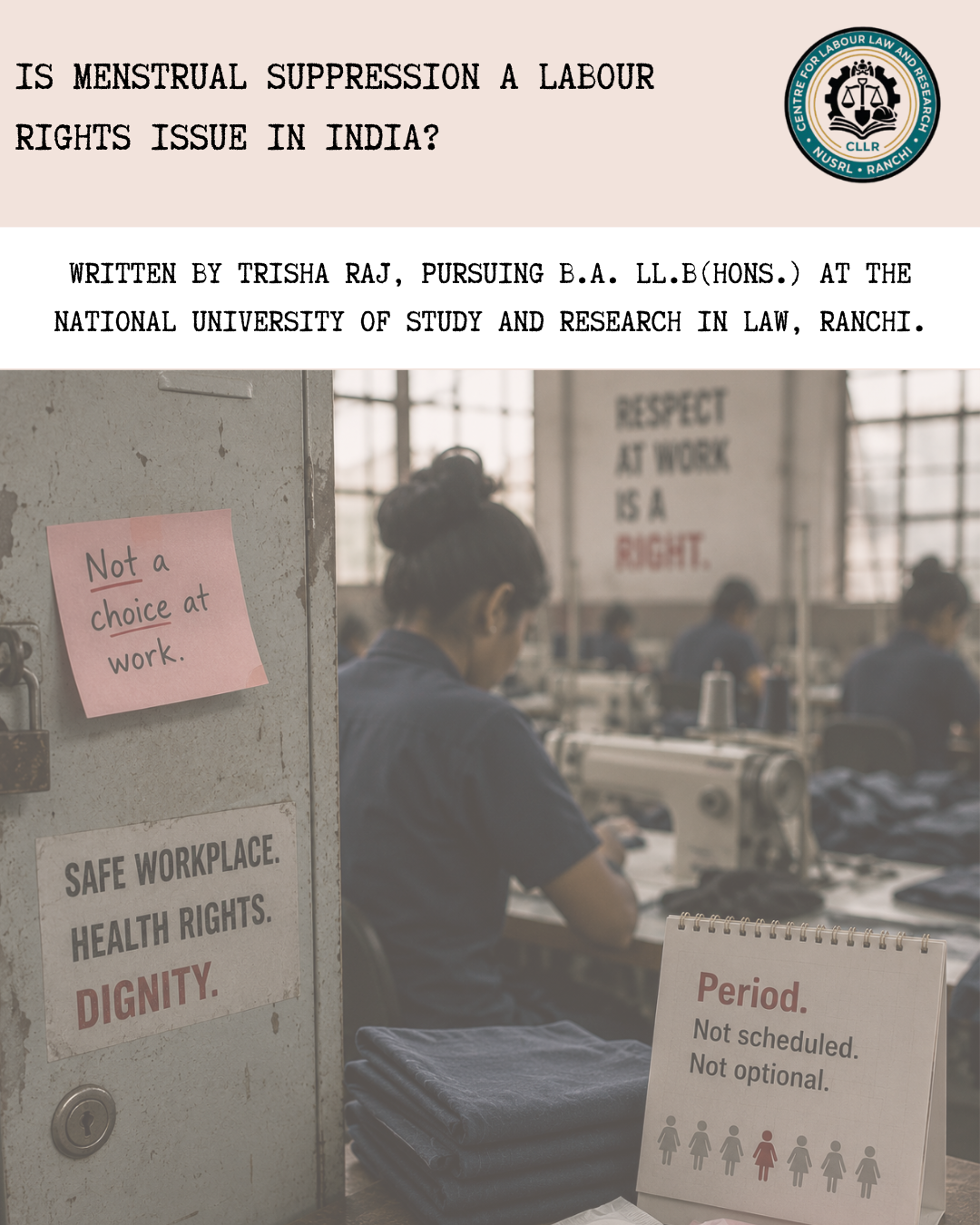
The workers from garment factory in Tamil Nadu, works for a billion-dollar established empire, yet they have been subjected to physical cruelty by opting for pills without any prescription from medical expert. As per the reports of Thomson Reuters Foundation, in 2019, women were given pills, to ease their menstrual pain and be more active in work, but the medicines lacked label, it was not brought from any chemist shop, rather it was distributed to women by their contractors. Recent reports suggested that 78.3% of workers were not allowed to use washroom, in garment factories of Tamil Nadu, pushing many of the workers to drink less water, which eventually made them dehydrated and for women it worsened the condition for their reproductive health.
The inevitable health-deformity faced by women: Hysterectomies is removal of uterus from women body, in medical field it is only suggested in grave situations such as uncontrollable bleeding in uterus, cancer and fibroids. Forced hysterectomies causes fatigue, inability to bear children, osteoporosis and early menopause. Women workers from Beed complained about weakness and fatigue in their body, while working.
The women in Tiruppur, Tamil Nadu, complained about the depression, anxiety, urinary tract infections and miscarriages when they were fed the medicines lacking label or any information. The non-allowance of using bathroom, led to non-replacement of used period clothes with new one.
LABOUR LAWS AND GENDER EQUITY IN WORKPLACE
Article 41 of the Indian Constitution is often invoked in labour-rights and occupational-health discourse because it links directly to the “right to work”. Article 42 goes a step further by demanding that worker’s workplace condition must be ‘just and humane’. This constitutional mandate is what directly led to landmark protections like POSH Act and paid maternity leave.
The section 23 of OSH Code, empowers the appropriate government to prescribe canteens (100+ workers) first aid boxes, an ambulance room in every work site and also sufficient arrangement of washrooms for male, female and transgender persons. But in the situation of workers from garment factories and spinning mills across the state of Tamil Nadu, unlabeled Pills are generally given to women without any consultation from doctors, to avoid any hinderance in the productivity, and most these factories seldomly has any ambulance room in their area. The Beed region lacks proper washrooms, and workers in Tamil Nadu, are forced to not use the right of using toilet. The section 60 of the OSH Code, casts a duty on every contractor or employer engaging inter-state migrant workers to ensure suitable working conditions, given that such workers operate far from their home states; to report any fatal accident or serious bodily injury to authorities in both the source and destination states, as well as to the worker’s next of kin. But contrast to this provision the contractors are involved in suggesting hysterectomies to workers and promoting dehydration among the workers.
In the case of Dr Narendra Gupta versus Union of India & Ors, the former Chief Justice of India (CJI) D.R. D.Y. Chandrachud observed that:
“The right to health is an intrinsic element of the right to life under Article 21 of the Constitution. Life, to be enjoyed in all its diverse elements, must be based on robust conditions of health. There has been a serious violation of the fundamental rights of the women who underwent unnecessary hysterectomies.”
The miscarriage caused by taking pills, and the weightage of never bearing any child in near future is traumatizing enough to have separate laws regarding women when it comes to their body and providing labour in India. Even in the case of Suchita Srivastava & Anr versus Chandigarh administration, decided on 28 August, 2009, a mentally-disabled pregnant woman was given chance to state her choice regarding completion of her gestation period. But in the case of female workers, their choices are often laced with livelihood stability threshold. They can either choose to have healthy and nurturing body or to have a life where they can afford a meal twice a day. It is failure of both administration and statutes to promote perilous structures designed especially for women, where everything served on their plate comes with repercussions. The consent which is taken from these women on the defense of Violenti non fit injuria (to a willing person, injury is not done), should be deconstructed as structural myth, which was taken from them when they were under unequal economic conditions. In the case of Samira Kohli vs Dr. Prabha Manchanda, the court stated that “Patients have a right to information about their condition and the treatment options available to them.” And in the matter of Beed workers, they have the rights to know the other options that are available to them rather than going through complete removal of uterus.
As per the study conducted by Prof. Prabha Kotiswaran on social Reproduction theory and Labor law, she argued that labour law fails because it only protects the worker at machine, completely ignoring that bodily maintenance is also very important to put that worker there.
When women enter the formal and informal work sector in Tamil Nadu and Beed, the employers are not restructuring their policies to adhere with the biological needs of women, rather they are demanded to adapt as per the male baseline of uninterrupted productivity. And if they do not adapt by themselves, there are bitter consequence such as non-hiring of female workers. Women workers are already not preferred in most industries because of their unavailability at work during their periods. But if an industry claims and put forward certain conditions of non-hiring due to menstrual leave or states that they can’t hire workers who become less productive, they are indirectly confessing that their workplace is based on exploitation.
SUGGESTIONS
- State Government must ensure that washrooms and restrooms are available at every factory, mill, construction sites and other places, where women are hired to work. The availability of resources related to hygiene must be available at every workplace.
- Monthly inspection by the appropriate government, regarding the condition of the work place, and the conduction of grievance hearing session for the workers regarding problems faced by them in their course of employment.
- Cancelling licenses of hospitals and medical practitioners, involved in performing hysterectomies, without any solid need for it. Accountability for inducing and coercing women to go through unrequired surgeries.
- Factory management or employer should be held strictly liable for distributing unlabelled, non-prescription pills. And mandatory establishment of ambulance rooms managed by certified medical practitioners.
- Following the precedent in Samira Kohli v. Dr. Prabha Manchanda, employers and local health centers must ensure female workers are fully informed about alternative medical treatments before undergoing permanent surgeries like hysterectomies.
- The garment factories disallowing the use of toilets in workplace, should be legally responsible for health deterioration of the workers.
- Industries must align their operational policies with the biological needs of women by normalizing flexible and balanced working hours. Paid menstrual leaves must be made mandatory and binding.
Caveat: The views, analyses, and information presented in this article are provided in good faith and for general informational purposes only. No representation or warranty, express or implied, is made regarding the accuracy, adequacy, validity, reliability, or completeness of the information. Readers should conduct their own research and seek professional guidance where appropriate. Neither the author nor the publisher shall be held responsible for any loss, liability, or consequence arising from reliance on this content.
Leave a Reply