

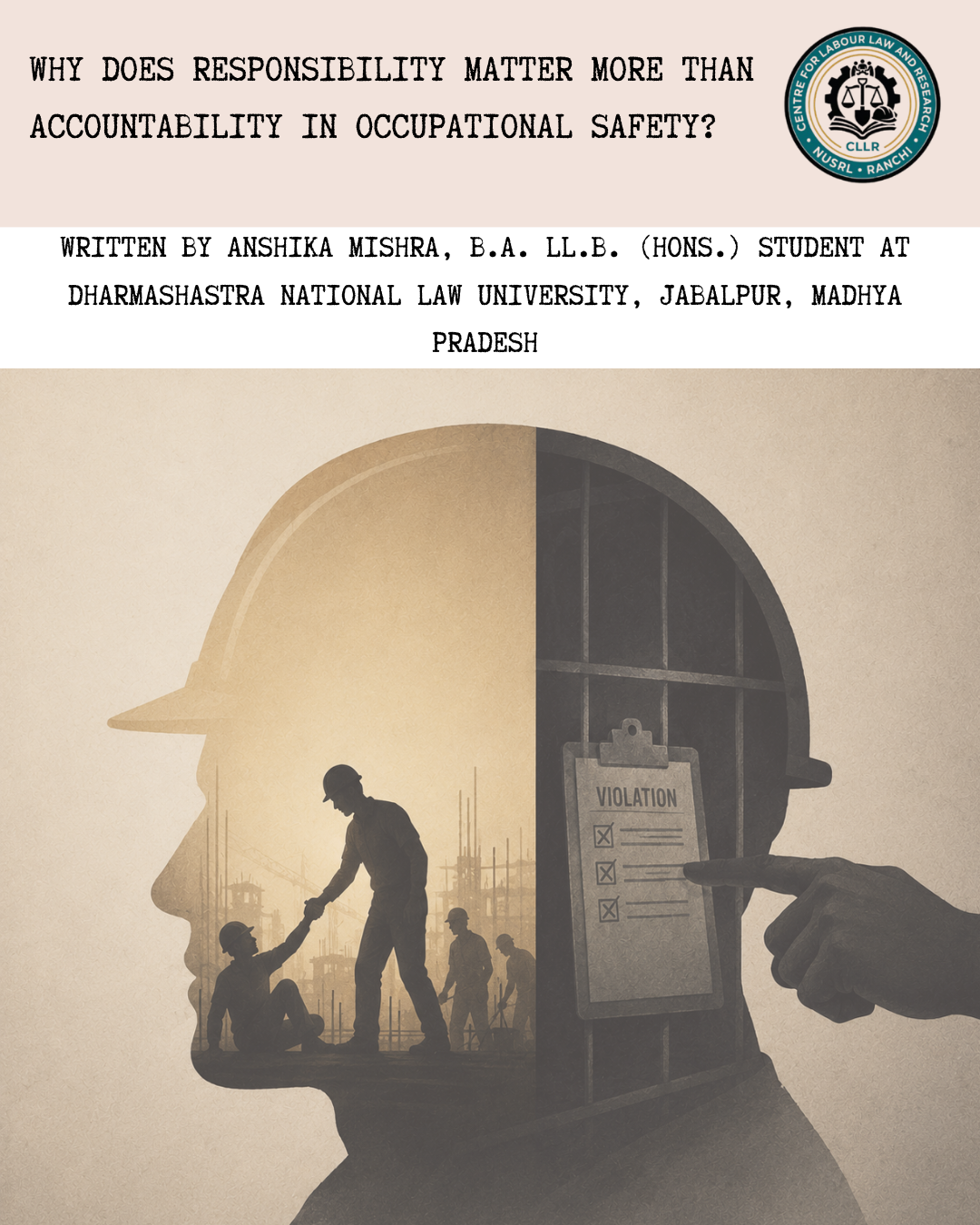
Written by Anshika Mishra, B.A. LL.B. (Hons.) student at Dharmashastra National Law University, Jabalpur, Madhya Pradesh
It is unfortunate to come across the instances of deaths due to industrial accidents and mis happenings every day. A report suggested that more than two millions death occurs globally owing to workplace accidents and diseases. India alone constitutes nearly 48,000 annual deaths because of occupational hazards. Such numbers demand for something much more than carrot-and-stick approach of what is known as accountability. It demands better acknowledgement and response of the institutional failure to provide the necessary safety measures to the workers. It requires a sprint towards responsibility.
- Why Accountability do not suffice?
As per Cambridge dictionary, Accountability requires (a) the fact of being responsible for what you do, and (b) ability to give a satisfactory reason for it. Accordingly, Accountability is categorized by its reasonableness rather than its spirit. It is a system which follows positive and negative reinforcement. The employers are rewarded a carrot (reward) – an escape from liability or stick (punishment)- penalties depending on their fulfilment of necessary protocols of safety. This sounds great on paper but ensuring occupational safety effectively demands much more than mere fulfilment of necessary compliance. It demands immediate actions and regular revision of safety measures. A lot of the accidents are outcome of immediate fault and negligence, that are ignored as a reason of accountability due to its ‘unreasonableness’. The employers escape liabilities due to absence of prior stipulation of outcome or mishappening. The biggest limitation of accountability is that it is limited to the fulfilment of necessities but ignores the realistic demands of the workers. A lot of labour disputes arises because of the distinction of both. This systematic void needs something more than mere accountability.
- Why Responsibility is better?
The same dictionary defines Responsibility as “good judgement and the responsibility to act correctly and make decisions on your own”. Responsibility is a wider concept than accountability and accountability is just one aspect of it. Responsibility covers broader concerns such as stipulation of ways to ensure the workers are in a safe condition to work, their health and welfare. The employer owns a sense of duty towards his employees rather than a sense of just ensuring the necessary compliance to the legislations. Responsibility is characterised by own motivation to progress while accountability just demands an answerability to others.
Amartya Sen has emphasized on the importance on the ability of responsibility as an immense force of bringing social progress. The employer is accountable to take necessary measures to ensure safety of his workers to the extent that it can be monitored. On the flip side, the employer is responsible to ensure his workers safety beyond monitoring. The self-motivation can be a great source of innovation and creativity beyond the limitations of accountability.
- Is there no need of Accountability altogether?
It is important to move toward a regime of responsibility but neglecting the accountability of the employers to ensure necessary compliance can be fatal. What we require is a systematic change in the origin if the sense of responsibility of the employer towards his workers and workplace. The employers should not take decisions from the perspective of escaping liability in case of any mishap but their decision should arise from the sense of duty towards his employees. In fact, Responsibility and Accountability compliments each other in terms of means that can be used to promote each other. For instance, it would be easier for the employer to regulate and monitor the health of his workers if the workers visit the hospital or medical centres regularly for check-ups and submit the report to the employer regularly. Here, the responsibility of the worker towards his health has induced the fulfilment of accountability of the employer/manager. If the workers do not turn up for health check-ups regularly, it would be difficult for the employer to take necessary steps to ensure the safety of the workers. Hence, both responsibility and accountability can co-exist.
The concluding idea is to move towards responsibility regime rather than following the outdated and ineffective accountability structure. There must be a change in the sense of how seriously occupational safety of the workers are dealt with. The employers are required to be motivated to ensure the safety of his workers rather than merely fulfilling some black letter requirements. The employer is also required to update his safety policies regularly and take immediate actions in case of any estimation of fatalities.
Caveat: The views, analyses, and information presented in this article are provided in good faith and for general informational purposes only. No representation or warranty, express or implied, is made regarding the accuracy, adequacy, validity, reliability, or completeness of the information. Readers should conduct their own research and seek professional guidance where appropriate. Neither the author nor the publisher shall be held responsible for any loss, liability, or consequence arising from reliance on this content.
Leave a Reply