

Written by Ayush Raj Singh student at Hidayatullah National Law University, Raipur.
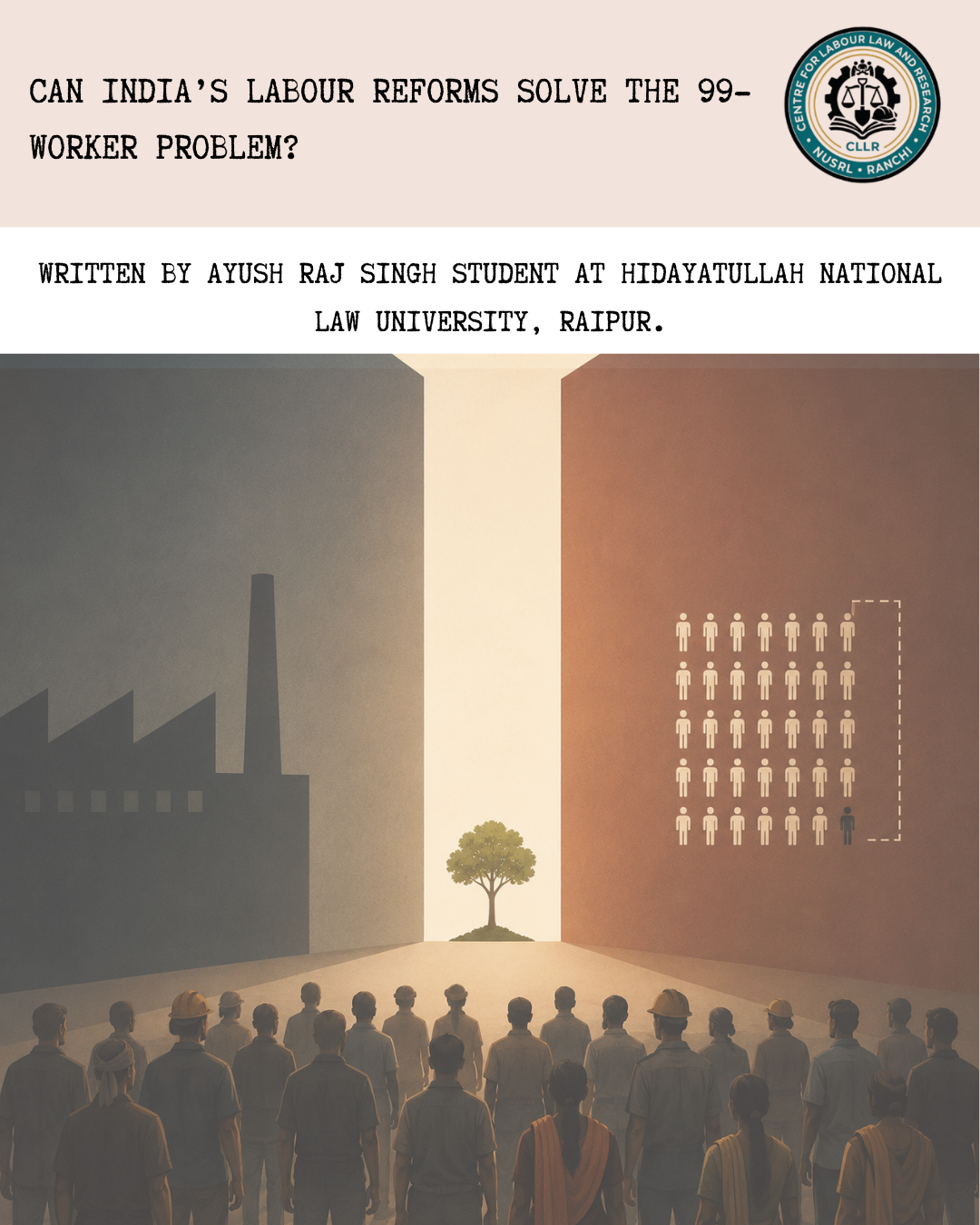
Imagine an employer running a manufacturing unit in Mumbai with 98 workers. He gets a new contract, and it is big enough that 98 workers won’t be enough for it. The ideal thing here will be hiring a few more workers who are needed for the job, but the twist is that crossing the 100-worker mark under the newly notified Central Rules of 2026 triggers a mandatory canteen obligation. The employer has to bear the extra cost of infrastructure,a cook and recurring maintenance and all this for hiring two or three more workers? Which doesn’t sound realistic for small businesses running on thin margins. He has two options now: either don’t hire any more workers or hire them on a contract basis. , keeping your official headcount at 98. The contract gets done. The workers remain precarious. And the law designed to protect them has quietly worked against them.
This is called the “threshold trap”, and it sits at the heart of India’s most ambitious labour law reform in decades.
On 8th May 2026, the Ministry of Labour and Employment issued the much-awaited Central Rules in all four Labour Codes, the Code on Wages, the Code on Social Security, the Industrial Relations Code and the Occupational Safety, Health and Working Conditions Code. The rules are rightly commended for their digital focus, recognition of gig workers, and the ability to streamline an uncoordinated compliance landscape. However, what has been almost completely overlooked in their progressive architecture is a series of thresholds, each of which is workforce size, that, together, provide a powerful financial incentive for employers to remain small, informal, and just under the threshold.
A FAMILIAR GHOST IN A NEW FRAMEWORK
This isn’t some new problem; this issue has always been around labour laws. It just makes its reappearance 2026 with even more intensity.
The most infamous example of it is Section 25N of the Industrial Disputes Act, 1947, which stated that any establishment with 100 or more workers requires government approval before it could retrench any employee or close down. This resulted in the so-called “99-worker problem”, a well-documented phenomenon where firms deliberately capped permanent headcount at 99 to retain workforce flexibility. Hasan and Jandoc (2012), drawing on annual survey data, found that the labour-intensive manufacturing enterprises with 50 to 99 workers, precisely the band just below the 100-worker threshold, saw the steepest growth in contract labour.
Unfortunately, poorly designed protective regulations can drive economic activity from the formal to the informal sector instead of making it better in the formal sector. There is a solid academic basis for this concern. In their seminal paper published in the Quarterly Journal of Economics (2004), Besley and Burgess showed that state laws that tightened labour market regulation in the direction of formalisation led to rises in informal manufacturing output.
The architects of the 2026 Labour Codes were aware of this as evidenced by the fact that the Industrial Relations Code directly responded to it by raising the retrenchment threshold from 100 to 300 workers, a clear recognition of the fact that the old cliff edge was affecting employer actions. This was a right and timely patch.
The painful irony is that while correcting one threshold problem, the 2026 Rules have quietly created several new ones.
THE COMPLIANCE CLIFF: WHAT THE 2026 RULES ACTUALLY SAY
The Central Rules notified in May 2026 under the four Labour Codes place a series of obligations on the workforce size of establishments.
An establishment, once it reaches the number of 20 workers, is required to form a Grievance Redressal Committee under the Industrial Relations Code, and a specific requirement is that women workers be adequately represented. The OSH Code comes into effect at 50 workers, where a crèche facility is required, which includes specified space, trained personnel and regular running costs. A canteen facility is a big investment in infrastructure, with a recurring cost of staff, and is required once the workforce reaches 100. Lastly, when the number of workers at the establishment reaches 500, the duties further increase: the establishment must have an ambulance room equipped by a qualified medical practitioner, and the establishment must form a Safety Committee, which must consist of an equal number of representatives from the employer and the workers.
Each of these obligations in isolation is completely reasonable; all of them were much needed for the betterment of workers. The problem isn’t the obligation; it’s the design. All the thresholds here are hard cliff edge, not gradual slopes. You don’t have any canteen obligation at 99 workers, but the moment you hire another worker, you have a canteen obligation. The trigger of these perverse incentives is the very binary nature of the obligation.
THE AGGREGATOR ESCAPE HATCH
So here is an irony that goes almost entirely unnoticed so far: the 2026 rules introduce a change for the first time, the central rules introduce a legal framework for the aggregator platforms and gig workers. Platforms that engage with gig workers now are required to register,share the data of gig workers with the government and fulfil the obligation under the social security code. Which is genuinely progressive.Millions of cab drivers, delivery workers, and freelance platform workers will now have a legal framework recognising them for the first time.
But consider the combined effect. An employer facing a threshold obligation now has access to a legally recognised, formally regulated alternative to permanent employment: the aggregator or platform model. Where the previous generation of threshold-avoiding employers turned to contract labour firms, the next generation can turn to platform arrangements with the added comfort that these arrangements now carry explicit government recognition and a defined regulatory framework. Many platforms are already classifying workers as “partners” to avoid the obligation.
The gig worker provisions were meant to ensure that a group of workers who were vulnerable to the informal economy would become a part of the formal economy. It’s a good idea. The Rules may inadvertently further foster the shift from permanent, formal jobs to gig jobs because they both endorse the aggregator model and provide threshold incentives to offshore labour. According to the NITI Aayog, India was home to about 7.7 million gig workers in FY 2020–21, which will swell to 23.5 million by 2029–30. If some of that growth is based on ‘threshold’ based externalisation of something that would be a permanent job, then the social cost is big and largely hidden in the sum of the statistics.
FROM CLIFF EDGES TO GENTLE SLOPES: A BETTER DESIGN
The threshold problem is not unsolvable. What it requires is a design intervention, and since many state governments are yet to notify their own rules under the Labour Codes, the window to act remains open. Three specific changes would materially reduce the distortion:
First, graduated obligations over hard thresholds. Instead of the full canteen requirement being triggered on the 100th worker, the rules might mandate a portion of an establishment’s workers to contribute to a common facility or a common pool of resources for compliance, based on the number of staff. It’s required at all sizes, but the cost is proportional with no cliff edge whatsoever.
Second, sector-specific calibration. a garment factory with 100 employees is very different from a software company with 100 employees. The needs of the worker are different, and so are the profits and revenue of both establishments. Imposing a uniform obligation on both ignores this heterogeneity. The rules should be sector-specific, where the compliance reflects the conditions of the industry.
Third, state-level experimentation with a minimum floor, since labour is a concurrent subject in the constitution, states are eligible to design their own threshold when notifying the rules. The centre should instruct the state to keep experimenting with graduated models,maintaining a minimum compliance floor to prevent a race to the bottom.state-level labour regulation already has deviations from the central rule, demonstrating that the state can deviate meaningfully from the central rules.
The central rule of 2026 represents a genuine and progressive step towards the betterment of labour law in India. The shift to digital compliance, the recognition of gig workers, the Worker Reskilling Fund, and the consolidation of redundant registers were much-needed improvements in the labour laws.
But even with good intentions, a poor structural design can produce a bad outcome. The Threshold Trap isn’t a minor problem. This will shape the behaviour of millions of employers in the years to come and if ignored this might work against the very people whom this law is supposed to protect as witnessed by history, Employers will act rationally in response to cliff-edge cost triggers by reducing their headcounts before the trigger, by having more contract or platform workers, and by keeping the most vulnerable workers permanently out of the protection that these Rules are intended to bring.
India cannot afford to let an unintended consequence of labour reform deepen the very informality it was designed to fix. The consolidation of 29 laws into 4 Codes is a structural feat that took decades to be achieved. It would be a major disaster if that accomplishment was negated by a design flaw that was predictable and correctable.
State governments have yet to finalise their regulations. The Central Government is still empowered to clarify, amend and give guidance. The threshold trap is not fully closed.
Caveat: The views, analyses, and information presented in this article are provided in good faith and for general informational purposes only. No representation or warranty, express or implied, is made regarding the accuracy, adequacy, validity, reliability, or completeness of the information. Readers should conduct their own research and seek professional guidance where appropriate. Neither the author nor the publisher shall be held responsible for any loss, liability, or consequence arising from reliance on this content.
Leave a Reply