

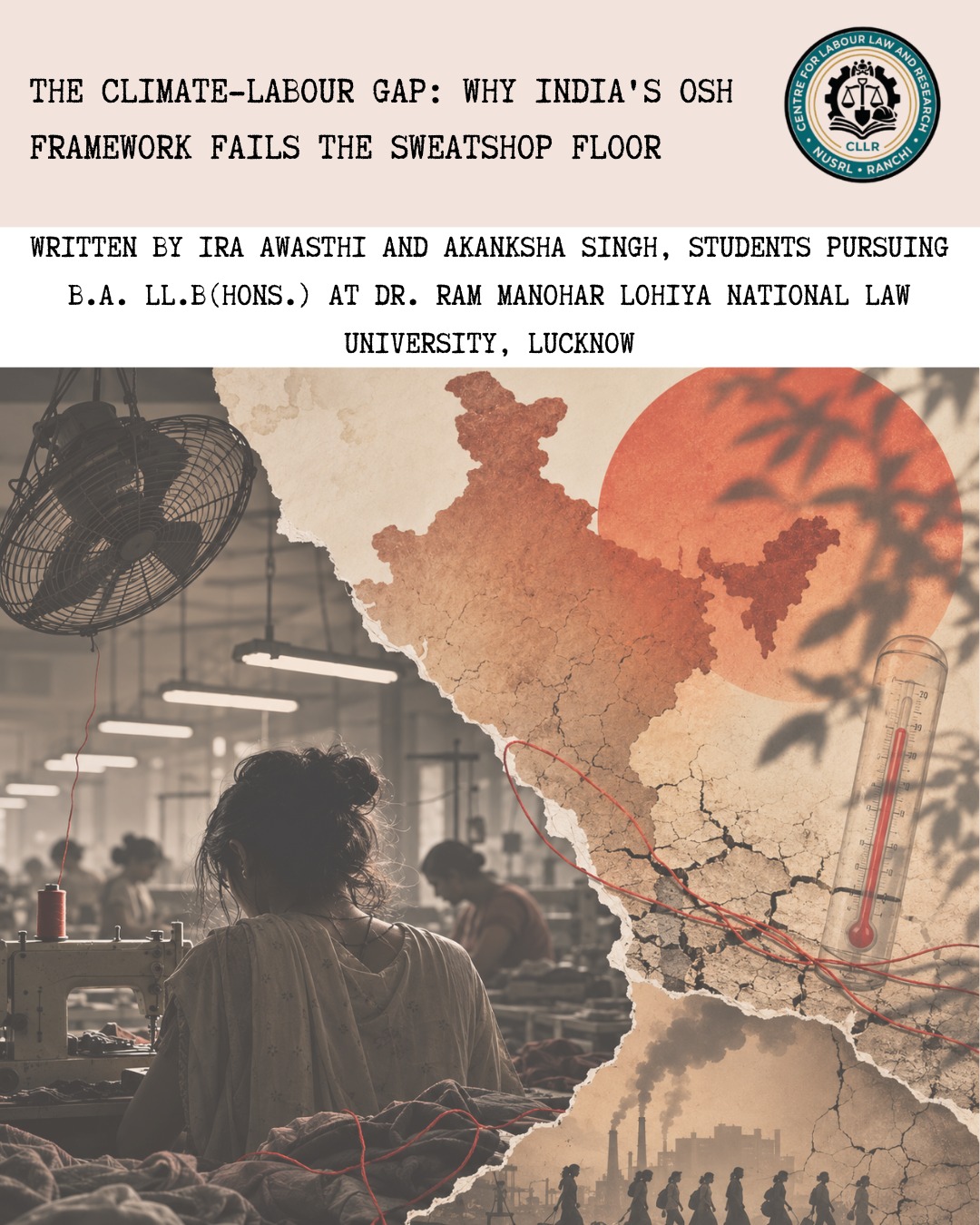
Written by Ira Awasthi and Akanksha Singh, students pursuing B.A. LL.B(Hons.) at Dr. Ram Manohar Lohiya National Law University, Lucknow
1. Introduction: The Industrial Frontline of Climate Change
India is in the midst of a significant weather change. Extreme heatwaves, which used to be considered anomalies, now predictably become crises each year, incapacitating industrial corridors and construction sites for months. The direct correlation between rising ambient temperatures and declining physical capacity is no longer just an ecological forecast infact it is an active economic and humanitarian disaster unfolding across the Indian labour landscape.
Labor compliance and occupational health systems as they are today are not structurally prepared to withstand this climate emergency age. Labour relations have traditionally overlooked thermal comfort as an amenity in the workplace. This article proposes to shift the discussion of the OSH Code 2020 from voluntary information disclosure by companies to increased regulation of the same, by forcing companies to behave by introducing a calibrated Wet-Bulb Globe Temperature (WBGT) indicator and imposing a ‘worker’s Right to Withdraw’ on the sweatshop floor as part of the legal framework.
In this article the argument stands that the objective occupational hazard, extreme heat, must be codified in the law by reading the M.K. Ranjitsinh (2024) climate justice precedent into the Constitution’s Article 21, exposing the structural failure of the OSH Code 2020, and recommending a transition from voluntary to hard statutory enforcement measures like calibrated Wet-Bulb Globe Temperature (WBGT) and a worker ‘Right to Withdraw’ on the sweatshop floor. Real labour protection needs to move away from corporate-oriented flexible reporting metrics to hard, law-based and scientifically sound thermal safety standards, which reflect the harsh realities of the most vulnerable members of the informal labour market.
2. Constitutional Architecture: Elevating Thermal Safety to Human Dignity
The evolution of the jurisprudence of Article 21 of the Indian Constitution is ongoing and always expanding. The Supreme Court has said many times that the “Right to Life” is not limited to animal life, but it is life with basic human dignity. Part of that dignity is a safe, humane and survivable work place. If an employer requires a worker to enter an uncooled area at extreme temperatures, then it’s not only a regulatory violation, it’s a violation of the worker’s constitutional rights to bodily integrity.
The constitutional law of this nature underwent a sea change in the case of M.K. Ranjitsinh & Ors. v. Union of India & Ors. SC OnLine SC 570 was a massive step by a three-judge bench led by Chief Justice D.Y. Chandrachud, in making the “right to be free from the adverse effects of climate change” explicit under Article 21 and 14. In this case, the Court found that the right to life is linked to the “whole environment,” which encompasses the right to be free from the harmful impacts of climate change. This decision offers a much-needed instrument in the judicial process for reshaping Indian labour rights. Logically, if the right to life is guaranteed against the effects of climate change, then the workplace is included in the scope of that protection, since millions of citizens are working during the day and are exposed to dangerous heat in the workplace.
Moreover, the Court explicitly recognised how the increase in temperatures accentuates the pre-existing socio-economic inequalities, firmly establishing this reality in the context of Article 14. It said the impact of climate change on the right to equality is manifested in terms of differential impacts, as poorer and marginalised communities are more affected by environmental degradation than the richer ones. In the industrial world, this translates to the fact that executive management can comfortably work in a controlled climate environment, whereas the working class and manual labourers are subjected to climate extremes. This constitutes a clear violation of Article 14 which is not covered by existing labour laws. In a clear reference to the rising temperatures, the Court explicitly identified this as a new constitutional intervention and provided researchers with a direct mandate to use this precedent on the factory floor.
The expanded rights contained in the Articles 21 and 14 have been backed by the Directive Principles of State Policy. Article 39(e) requires the State to ensure that the health and strength of workers is not exploited and Article 42 makes it a specific duty for the State to ensure just and humane conditions of work. In combination with M.K. Ranjitsinh, these provisions make thermal safety a mandatory constitutional duty, as opposed to being a corporate social responsibility effort.
3. The Legacy Framework vs. The OSH Code 2020: An Analytical Critique
Section 13 of the Factories Act 1948 was the main legislation that protected workers against heat in the workplace for more than seven decades. Under Section 13(1) factories had to provide reasonable conditions for comfort and to separate heat-producing activities to prevent health injuries. Section 13(2) empowered the state governments with quantitative standards of temperature. But this legacy model presents a major structural drawback, namely that the temperature is considered a closed engineering problem that can be solved by simple adding of fans or ventilation. It simply doesn’t consider contemporary climate conditions in which heatwaves in the macro-environment collide with heat islands in the urban environment, leading to a failure of the traditional cooling system.
India’s labour laws were brought together in the four National Labour Codes, which presented a great opportunity to modernise these protections. Sadly, the Occupational Safety, Health and Working Conditions Code 2020 fell short. Section 6 of the OSH Code specifies a general “Duties of the Employer” that all workplaces must be free from recognized hazards that can cause or are likely to cause injury or occupational disease. The fundamental defect in Section 6 is that it is confusing and uncertain. Employers are routinely found not liable because the code does not explicitly identify ambient environmental temperature limits as a recognized hazard. They consider heat stroke, Chronic Kidney Disease due to dehydration and thermal exhaustion to be personal health problems not workplace injuries.
Section 23 of the OSH Code 2020 compounds this issue by shifting standard-setting power away from specific statutory mandates and centralizing it within the discretionary rule-making authority of the Central Government. Centralisation brings about convenient uniformity but removes accountability at the local, state or regional level. The OSH Code deletes the concrete, unyielding statutory requirements, and substitutes them for flexible administrative guidelines, making thermal safety subject to corporate lobbying and bureaucratic delay.
The biggest shortcoming of the thermal aspect of the OSH Code is the scope of coverage. The code’s safety requirements are linked to the formal and registered establishments. This has rendered India’s most vulnerable workforces totally unprotected. Contract workers and outsourced workers are legally covered, but the level of their safety is not readily apparent because of complex sourcing arrangements and not being directly responsible to the employer.
In addition, gig economy and platform workers, such as delivery workers, work outdoors all day long during heat waves, which are often characterized by high traffic volumes. Also gig economy and platform workers are forced to work outside during the entire day on hot days, when there is a high volume of traffic. They are not considered to be employees, so they are not subject to any provisions of the OSH Code.
4. Quantifying the Danger: Shifting to the Wet-Bulb Globe Temperature (WBGT) Standard
The law needs precise scientific parameters in order to create a comprehensive law. Existing state factory regulations are almost entirely based on standard air temperature (or dry-bulb temperature) readings. It is a serious fault in regulation. Dry-bulb thermometers will only read air temperature and do not account for humidity, wind speed or radiant heat. The worker who works in a humid textile mill or a construction site directly exposed to the sun, is under extreme metabolic stress which a regular thermometer cannot measure.
To fill this gap, Indian labour policy needs to move towards internationally accepted Wet Bulb Globe Temperature (WBGT) index. WBGT differs from the ordinary dry bulb thermometer in that it takes into account the relative humidity of the air, wind speed, and radiant heat (direct sunlight or high levels of industrial machine radiated heat). This composite index includes the human evaporative cooling capacity in high humidity to account for this and gives an objective, scientifically unaltered baseline. Unlike just a temperature reading, specifying a particular WBGT value in legislation provides the courts and inspectors with a clear definition of when a workspace is objectively unsafe for performing manual work.
Without objective technical measures, the lack of measures serves to strengthen a predatory economic system called the piece-rate wage system. The agricultural workers, the brick kiln workers and the gig delivery riders’ pay is based on what they produce, e.g. per brick laid or per delivery. This leaves an ill-informed economic incentive. Workers are regularly pushed beyond their physiological capabilities, leading to heat stroke, organ damage over time and death due to the need to miss out on valuable income during a break. To reverse this trend, a metrics-driven legal protocol needs to be implemented that requires non-deductible rest periods, based on real-time WBGT levels, that are paid for.
5. Comparative Jurisprudence: The “Right to Withdraw” and Supply Chain Realities
India can look up to the European labour traditions to make up for the lack of transparency and actual worker safety. The French Labour Code (Code du travail) lays down the doctrine of Droit de Retrait (Right to Withdraw) in article L4131-1. This law allows an employee to leave their work area when they reasonably believe there is a grave and imminent danger to their life or health. Importantly, there is no right to be paid less, penalized or fired for exercising this right. This doctrine will enable workers to safely halt operations when a severe heat wave occurs when ambient temperature exceeds safe limits.
This notion of a right to withdraw is entirely in harmony with present day Indian constitutional theory. The Supreme Court in Consumer Education & Research Centre v. Union of India (1995) 3 SCC 42 held that the right to health is an unalienable part of Article 21, which means that the health of a worker can never be sacrificed for the industrial productivity. The same principle was reiterated in the Occupational Health and Safety Association v. Union of India (2014) 3 SCC 547, where the Court explained that the State is required to periodically improve its safety protocols in order to keep up with the changing nature of occupational hazards.
Thermal stress is precisely the type of hazard that the Court expected to evolve in response to climate change. The Droit de Retrait needs to be read into Section 6 of the OSH Code in a localized form with respect to India. The India Meteorological Department (IMD) must give workers a legally protected right to stop physical work or move to a safe cooling area when it issues a red alert and/or when localised WBGT monitors exceed dangerous levels, without threatening to cut their pay or to terminate their employment.
In parallel, international regulatory mechanisms are developing an alternative market oriented route to regulating labour enforcement, with domestic processes yet to come to completion. The Corporate Sustainability Due Diligence Directive (CSDDD) in the European Union (EU) is a new law requiring multinational brands to legally audit human rights and environmental safety across their global supply chains. International auditing organisations carry out strict private spot-checks on Indian apparel, software and manufacturing centres, which are considered to be tier-1 and tier-2 exporters. If the audit finds that the Indian exporter is having a factory that is producing output beyond safe thermal parameters, and he was not installing calibrated electronic WBGT meters or providing work-rest schedule, he will be liable to huge penalties under the home country law. This is a commercial risk that international buyers often take advantage of by resorting to immediate termination of the contract as a penalty. It is a fact that in private contractual enforcement, Indian Boardrooms are compelled to make occupational thermal safety a non-negotiable requirement when going global.
6. Regulatory Proposals: Amending Rules and Framing Strategic Accountability
Enforcement needs to go beyond the listed requirements to address the informal workforce which has no protection. Section 23 of the OSH Code 2020 requires state governments to incorporate an enforceable work rest schedule which directly relates to actual WBGT measurements into the State OSH Rules. These rules, which apply to all registered industrial establishments, workshops and construction sites, remove the “corporate filter. This framework should include clear thresholds for operation. Normal operations can proceed with regular hydration checks up to 30°C WBGT. Moderate and heavy labour should have a mandatory 15 minutes cooling break every hour when metrics reach 30.1°C. In the orange tier (31.6°C to 32.2°C) paid breaks are extended to 30 minutes and all outdoor manual work in direct sunlight is stopped. Lastly, when the temperature hits 32.2°C, all outdoor and uncooled indoor manual work should be stopped immediately without any loss of daily wages; and workers should be moved to a cool shelter.
This framework needs to be directly connected with corporate finance through the SEBI Business Responsibility and Sustainability Reporting (BRSR) framework for ensuring compliance, not just relying on the overburdened state factory inspectors. Listed companies must be mandated to report the days of operations when local WBGT readings were above dangerous levels; the days when engineering controls were employed in-house to reduce the indoor working temperatures of employees and evidence that the contract and value chain labourers were paid their full wages during climate stop work periods. The link of thermal safety to a company’s public ESG rating will place corporate boardrooms under pressure to make climate adaptation a core fiduciary duty, under the Companies Act 2013 Section 166.
Climate change and labour law is one of the major human rights issues of this century. The traditional guidelines and policies on extreme heat, which were developed during the colonial era and view it as a minor inconvenience, are antiquated and no longer relevant in India. The scientific rigour of the WBGT index and constitutional robustness of Article 21 and M.K. Ranjitsinh create a promising template for a new, progressive approach to Climate Labour Law in India. The right to a safe livelihood must never exclude the basic right to a survivable workspace in order to have workplace justice.
Caveat: The views, analyses, and information presented in this article are provided in good faith and for general informational purposes only. No representation or warranty, express or implied, is made regarding the accuracy, adequacy, validity, reliability, or completeness of the information. Readers should conduct their own research and seek professional guidance where appropriate. Neither the author nor the publisher shall be held responsible for any loss, liability, or consequence arising from reliance on this content.
Leave a Reply