

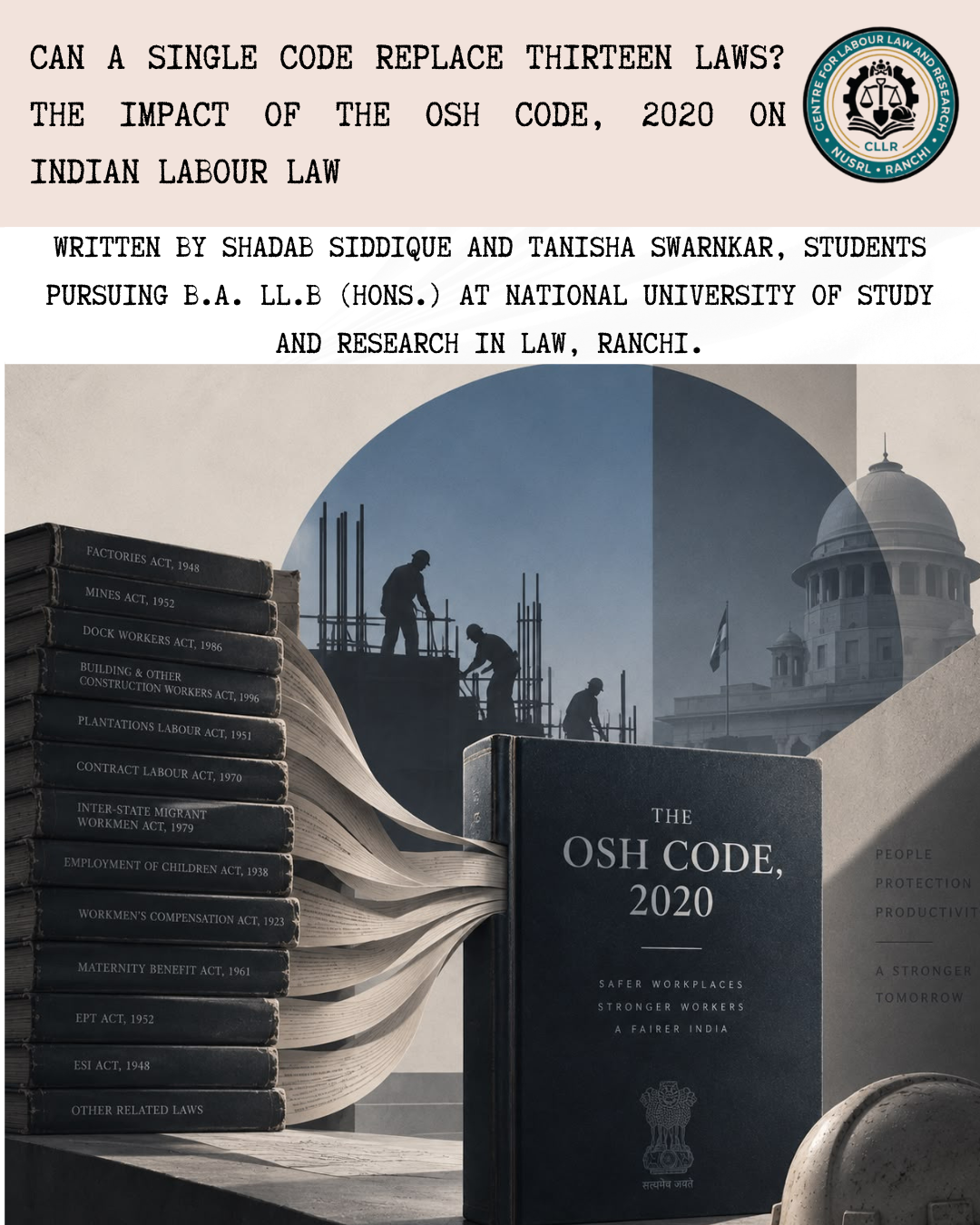
Written by Shadab siddique and Tanisha swarnkar, students pursuing B.A. LL.B (Hons.) at National University Of Study and Research in Law, Ranchi.
A spray dryer exploded at Sigachi Industrie’s plant in Pashamylaram, Telangana on the morning of 30 June, 2025. Eventually, the death toll was 54. The majority of the deceased were migrant workers from Bihar, Jharkhand, Odisha, West Bengal and Uttar Pradesh, and this was after a shortcoming was noted in firefighting equipment and emergency exits during a December 2024 inspection by the Factories Department. The plant registered and inspected. The law was there at all points but not at the point that counted.
All four labour codes were enacted by the Union Government within a span of less than five months of time on 21st November 2025. While reading the Occupational Safety, Health and Working Conditions Code, 2020, one awkward question cannot be setoff: would it have made a difference at Sigachi?
FOUR CODES, ONE SHIFT
The codes compile 29 central statutes into four: the Code on Wages, 2019, the Industrial Relations Code, 2020, the Code on Social Security, 2020 and the OSH Code. The concept goes dates back to 2002, during the Second National Commission on Labour. The codes do not alter what is contained in any specific right, but the structure of the regulation. Laws organised by industry give way to laws organised by function. The inspector who prosecuted is recast as an Inspector-cum-Facilitator, paper registers move to a portal, and many offences once punishable with jail can now be compounded.
Supporters call this a long overdue clearing of an old ticket. Critics call it dilution by reorganisation, and ten central trade unions struck against the codes on 12 February 2026. Both readings can be drawn from the same text, which is why the OSH Code requires close study.
Parliament passed the Code in September 2020 and it received assent on 28 September as Act No. 37 of 2020. It then lay dormant for five years. After commencement in November 2025, the Centre pre-published draft rules on 30 December and notified the OSH (Central) Rules, 2026 on 8 May 2026. Labour being a Concurrent List subject, States must frame their own rules, and many were still at the draft stage by mid-2026, with legacy rules filling the gap.
The Code subsumes 13 laws, including the Factories Act, 1948, the Building and Other Construction Workers Act, 1996, the Contract Labour (Regulation and Abolition) Act, 1970 and the Inter-State Migrant Workmen Act, 1979. According to the Government’s own figures, 620 sections reduce to 143, six registrations to one and 21 returns to one and 21 returns to one. The obligations for safety and welfare are extended from seven named sectors to any establishment with ten or more employees, and a proviso to the definition of “establishment” permits the Centre to notify incidences of hazardous or life threatening activities for which there is no headcount requirement.
Employers must issue appointment letters and provide free annual health examinations, although the Central Rules restricts the latter to workers aged forty and above, however workers at docks and hazardous process workers are covered at any age, meaning that the Code’s promises are as broad as its rules. A single tripartite National Occupational Safety and Health Six sectoral boards are replaced by one tripartite National Occupational Safety and Health Advisory Board, which gives guidance on national standards which States are obliged to adhere to. Safety committees are required only in factories of 500 employees or more, construction sites of 250 or more and mines of 100 or more
Enforcement softens and sharpens at the same time. Inspections are meant to be random and online, and for a first offence involving no accident section 110 gives employers thirty days to put things right before prosecution. But where a contravention causes death, according to section 103, imprisonment term is up to two years and a fine of at least five lakh rupees, or both, and the court may direct half the fine or more to the victim’s heirs. It is not a measure of what a hazardous enterprise owes, but the basis of absolute liability rule in M.C. Mehta v. Union of India, (1987) 1 SCC 395.
Two reforms are noteworhty. Section 43 entitles women to work in all establishments and, with consent and prescribed safeguards, at night, reflecting Supreme Court’s warning in Anuj Garg v. Hotel Association of India, (2008) 3 SCC 1, that protecting women cannot become a licence to exclude them. The definition of inter-state migrant worker also now covers people who migrate on their own, with an annual journey allowance and portable construction welfare benefits
TARGETS AND OBJECTIVES
The Government sees the Code as achieving two aims: safer workplaces and a more business friendly regulatory environment. Read against the case law, a third aim appears: giving statutory form to rights the Supreme Court had already located in Article 21. In Bandhua Mukti Morcha v. Union of India, (1984) 3 SCC 161, the right to dignity was held to include protection of worker’s health and “just and humane conditions of work”. In Consumer Education and Research Centre v. Union of India, (1995) 3 SCC 42, a case about asbestos, the Court treated worker’s right to health as fundamental, describing occupational disease as “the most appalling human tragedy of modern industry”. In Occupational Health and Safety Association v. Union of India, (2014) 3 SCC 547, it handed the health of thermal power plant workers to the High Courts for continuing scrutiny. The Code is, in part, Parliament catching up with what judges had assembled case by case.
PROBABLE SHORTCOMINGS
The first worry is reach. As PRS Legislative Research notes, the Code raises the factory threshold from 10 to 20 workers where power is used and from 20 to 40 where it is not, and the contract labour threshold from 20 to 50. The defence is that low thresholds keep firms artificially small, the Economic Survey 2018-19 credited similar changes in Rajasthan with higher output. Yet the Anaj Mandi fire of December 2019 killed 43 people in a Delhi building quietly turned into a warren of small workshops. Danger often lives in exactly the units that fall below the line, and the hazardous-activity proviso protects them only if it is used.
The second worry is exemption. Section 127 lets States exempt any new factory from the Code to generate economic activity and employment, and section 128 allows exemptions during a public emergency, disaster or pandemic. Set that beside Gujarat Mazdoor Sabha v. State of Gujarat, (2020) 10 SCC 459, decided on 1 October 2020, three days after the Code received assent. The Court quashed Gujarat’s blanket lockdown era exemption from working hours and overtime protections, holding that economic distress was no “public emergency” under section 5 of the Factories Act and that the pandemic’s losses could not be passed on to workers. The Code now names “pandemic” expressly. Whether the Article 21 and 23 reasoning of Gujarat Mazdoor Sabha still disciplines sections 127 and 128 is a question the courts will almost certainly face.
There is also an international gap. Since June 2022 the ILO has counted a safe and healthy working environment among its fundamental principles, yet India has ratified neither of the two conventions that give it shape.
THE TEST AHEAD
The OSH Code is a better organised statute than the thirteen it replaced. Whether it is a safer one will be settled on factory floors. Sigachi had been inspected, what failed was follow through. An Inspector-cum-Facilitator who spots the next blocked exit and acts on it will vindicate the reform, and one who files a notice and moves on will prove the critics right. For us, the live questions are the State rules, first notifications under section 127 and first judicial reading under section 103. Protection is not a given with consolidation. If done properly, it can make protection more easily enforceable.
Caveat: The views, analyses, and information presented in this article are provided in good faith and for general informational purposes only. No representation or warranty, express or implied, is made regarding the accuracy, adequacy, validity, reliability, or completeness of the information. Readers should conduct their own research and seek professional guidance where appropriate. Neither the author nor the publisher shall be held responsible for any loss, liability, or consequence arising from reliance on this content.
Leave a Reply