

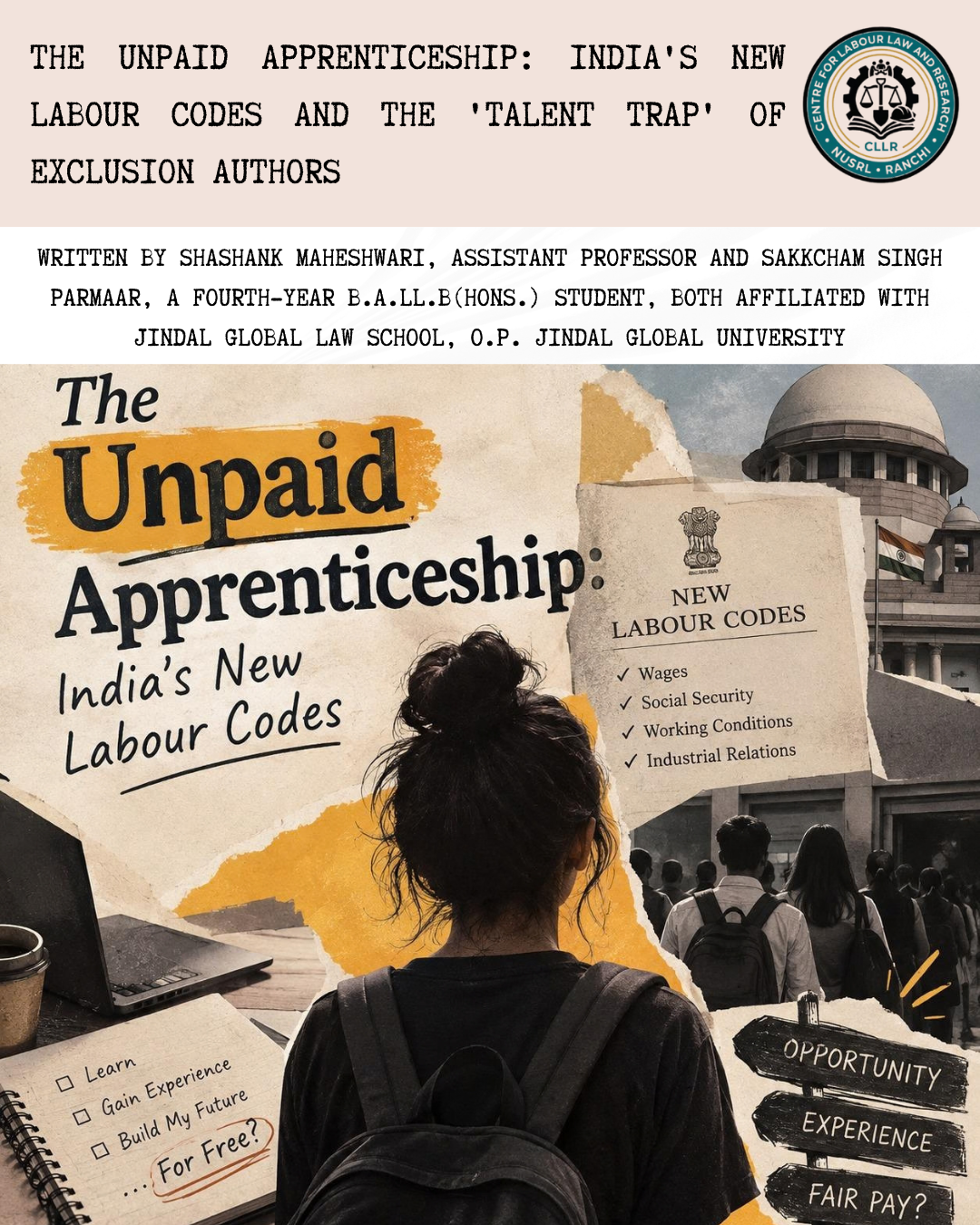
Written by Shashank Maheshwari, Assistant Professor and Sakkcham Singh Parmaar, a Fourth-Year B.A.LL.B(Hons.) student, both affiliated with Jindal Global Law School, O.P. Jindal Global University
Introduction: The Promise and the Paradox
The transition between academia and India’s professional sphere finds common ground in internships and apprenticeships, which offer a window to industry as a means of becoming industry ready. Such engagement is ruined by a talent trap, where young professionals are exposed to substantial, yet uncompensated, productive work, with no legal safeguards. With the implementation of India’s four new Labour Codes in November 2025, an interesting question arises as to whether or not the law has addressed the issue of the exclusion of young professionals or if the latter continue to be exploited under the guise of ‘exposure’.
The Legal Architecture of Exclusion
The central issue lies in the very definition of an apprentice, as contained in Section 2(aa) of the Apprentices Act, 1961, which provides that an ‘apprentice’ shall mean “a person who is undergoing apprenticeship training in pursuance of a contract of apprenticeship“. While the new Labour Codes offer more detailed and nuanced definitions of an employee and worker, they contain similar reservations. Thus, according to Section 2(k) of the Code on Wages, 2019, an employee is defined as “any person (other than an apprentice engaged under the Apprentices Act, 1961) employed on wages by an establishment to do any skilled, semi-skilled, or unskilled, manual, operational, supervisory, managerial, administrative, technical or clerical work for hire or reward“. Explicitly carving out apprentices, as defined under Section 2(aa) of the Apprentices Act, 1961, reads, instead, as an intentional legislative decision, which has been criticized.
Similarly, under the Industrial Relations Code, 2020 , Section 2(zk) defines a ‘worker’ with reservations as well. It defines a ‘worker’, subject to certain exceptions, as “any person (other than an apprentice as defined under clause (aa) of section 2 of the Apprentices Act, 1961)” thereby excluding apprentices, in their turn, from the scope of the Industrial Relations Code, 2020. As a result, they find themselves unable to access minimum wage protections, social security benefits, and even dispute resolution options. In turn, the Code on Social Security, 2020, similarly, follows a similar trend, as it does not extend its applicability to apprentices or to persons engaged in informal training arrangements.
The Parliamentary Standing Committee on Labour in its 2020 report on the Industrial Relations Code, 2020 acknowledges the issue, observing that, whilst apprentices are engaged in full-time continuous work by employers, they are paid stipends only. It recommends the “adoption of a consolidated and merged definition of worker/employee to prevent discrimination and specifically suggests that apprentices should be included under the definition of worker.”
The Regulatory Vacuum: Interns and the Absence of Legal Protection
While the situation is precarious already for persons engaged under training arrangements within the scope of the Apprentices Act, 1961, it is even more so for persons described as interns or trainees. Indian labour laws do not define these categories of persons and, thus, they constitute a regulatory vacuum in Indian labour law. Unlike apprentices engaged under the Apprentices Act, these arrangements carry a risk of misclassification, for courts recognize that an employer cannot deny an employment relationship merely by describing a worker as a trainee. Therefore, the critical indicator is whether or not an individual is subject to the supervision and control of an employer, and whether the person is treated, in practice, as an employee and not an auxiliary or subordinate.
Thus, in Ram Singh v. Union Territory, Chandigarh (2004) 1 SCC 126, the Supreme Court held that control is ‘one of the important tests but is not to be taken as the sole test,’ and that a ‘multiple pragmatic approach weighing up all the factors‘ including the integration test is needed to determine an employment relationship. The Court noted that “a consideration of whether the person was fully integrated into the employer’s concern or remained apart from and independent of it was required to ascertain the existence of a subsisting employment relationship”. Other relevant factors are considerations of who has the power to select and dismiss a worker, as well as who pays remuneration to the worker, organizes work, and supplies relevant materials. However, this jurisprudence has rarely been applied with regard to interns, who are often labelled trainees or even volunteers to avoid providing them with the protections that are due. Courts have used the organisation test and the control test in deciding questions relating to employer-employee relationships. Thus, in Hussainbhai v. The Alath Factory Thezhilali Union, the Supreme Court observed that “if the livelihood of the workmen substantially depends on labour rendered to produce goods and services for the benefit and satisfaction of an enterprise, the absence of direct relationship or the presence of dubious intermediaries or the make-believe trappings of detachment from the Management cannot snap the real life-bond.” Yet, these principles have not been carried forward to protect interns, who often engage in core activities for the employer and do not enjoy the same protections as formal employees would.
The Economic Filter: How Unpaid Work Perpetuates Inequality
The consequences of the exclusion of interns and apprentices from legal protections are severe, from an economic, as well as a constitutional, perspective. The talent trap acts as an economic filter in that it ensures that only those persons with financial means are able to pursue unpaid work and, therefore, access more competitive career paths. This is particularly visible in professions such as law, where early-career advocates are often burdened with substantial financial commitments.
The Supreme Court has recognized the severity of the issue in Gaurav Kumar v. Union of India (2025) 1 SCC 641, holding that “charging exorbitant enrolment fees and miscellaneous fees as a pre-condition for enrolment creates a barrier to entry into the legal profession“. Further, the Court observed that “the levy of exorbitant fees as a pre-condition to enrolment serves to denigrate the dignity of those who face social and economic barriers in the advancement of their legal careers“. Thus, collectively, they “perpetuate systemic discrimination against persons from marginalized and economically weaker sections by undermining their equal participation in the legal profession.”
Further, the issue of minimum wages for productive work raises the interesting question as to whether such an activity would fall within the scope of forced labour under Article 23 of the Constitution, which prohibits traffic in human beings and beggar and other similar forms of forced labour. In People’s Union for Democratic Rights v. Union of India (1982) 3 SCC 235, the Supreme Court has held that “forced labour” under Article 23 should be interpreted broadly to include any work which is “compelled by economic necessity and where the compensation is not adequate“. The Court held that “the payment of less than the minimum wage would be a form of forced labour” as the worker is forced to accept substandard wages due to his circumstances.
The Apprentices Act, 1961: A Flawed Framework
The Apprentices Act, 1961, which regulates the formal apprenticeship engagements is a flawed statute, itself, and does little to protect the rights of apprentices. In particular, Section 11 of the Act requires apprentices to receive a stipend “as may be prescribed“, which has not been revised to take inflation into account. The Act fails to provide apprentices with a comprehensive entitlement to social security benefits, such as provident fund, health insurance, or pensions. Section 17 states that “nothing in this Act shall affect the liability of any person to pay any tax or duty or to comply with any other law for the time being in force” but has been interpreted narrowly by courts to exclude apprentices from the scope of social security legislation.
The dispute-resolution mechanism is provided in section 20 of the Apprentices Act, 1961 which deals with disagreement or dispute arising out of a contract of apprenticeship, subsection (1) provides that it must first be submitted to the Apprenticeship Adviser for decision, and subsection (2) permits an appeal within 30 days from the decision to a committee of the Apprenticeship Council. Thus, although the provision creates an administrative adjudicatory route, it does not specify the remedies available and does not create a specialised adjudicatory forum; claims of its underuse or inadequacy need empirical evidence. The Apprentices (Amendment) Bill, 2006 proposed introduction in apprenticeship training of OBC reservation, greater flexibility in the engagement of apprentices, and a shift of the cost of related instruction to employers; it did not propose amendments relating to stipends or social-security protection.
The 2025 Labour Codes: A Missed Opportunity
The new Labour Codes, which were introduced in November 2025, promise universal minimum wages, mandatory appointment letters, and payment of wages in a timely manner for all workers. The PIB release spoke of a minimum wage that was guaranteed, a national floor wage, and the entitlement to a formal appointment letter. Presumably, the former would end the prevalence of unwritten arrangements in Indian workplaces, and the latter would entitle workers to a standardized set of rights and obligations. While the former appears to offer greater protections, the question of whether or not the Codes address the issue of the exclusion of apprentices and interns remains rather complex. The appointment letter is a welcome step, but its scope is contingent upon the interpretation of the relevant definitions. In fact, the Codes continue to make distinctions between different categories of workers. Thus, for example, the term worker under the Industrial Relations Code, 2020 contains exclusions for managerial or supervisory roles on the basis of the level of wages, and, consequently, their dispute resolution mechanisms are weaker.
Therefore, a person treated as an intern but as a trainee, rather than an employee may not be entitled to a formal appointment letter, or at least not in a straightforward manner. On the other hand, the Code on Social Security, 2020 (notified in 2025) states that it would extend certain benefits to gig and platform workers, as noted by the Economic Survey, 2025-26. However, they continue to exclude apprentices and informal training arrangements. The Social Security Code contemplates the establishment of a social security fund for such workers but does not make any similar provision for apprentices, placing them in a statutory no-man’s-land. The Codes fail to address the issue of the minimum stipend for interns and apprentices. The Code on Wages, 2019, which lays down the structure of the minimum wage, explicitly excludes apprentices, and, thus, they do not have an entitlement to a statutory minimum remuneration, which is a serious gap, as many internships and apprenticeship arrangements involve persons engaging in full time productive work, which would fall within the scope of the minimum wage provisions, had they been included.
Conclusion: The Urgency of Reform
With the new Labour Codes settling into the Indian legal landscape, their promise of universal social security and worker-centric reforms appears a bit too good to be true, in the sense that it does not reflect the experience of many at the grass-roots level. Their exclusion of apprentices and interns has created a talent trap of sorts, which has trapped young professionals at the first rung of the career ladder without their basic rights and dignity. The Parliamentary Standing Committee’s recommendation of a single, consolidated definition goes some way towards addressing this lacuna. If adopted, it will prevent the unwarranted differentiation and bring an entire generation of young workers within the ambit of the law. Until then, the promise of India’s labour reforms will remain unfulfilled, and the first rung of the career ladder will continue to be precarious and priced, as if for the privileged few only. The Supreme Court’s recognition in Olga Tellis v. Bombay Municipal Corporation (1985) 3 SCC 545 that the right to livelihood is integral to the right to life under Article 21 remains an unfulfilled promise for India’s young professionals. It is time to ensure that the talent trap is dismantled to ensure that every young worker, whether they are an apprentice or an intern, receives dignified compensation and legal protection.
Caveat: The views, analyses, and information presented in this article are provided in good faith and for general informational purposes only. No representation or warranty, express or implied, is made regarding the accuracy, adequacy, validity, reliability, or completeness of the information. Readers should conduct their own research and seek professional guidance where appropriate. Neither the author nor the publisher shall be held responsible for any loss, liability, or consequence arising from reliance on this content.
Leave a Reply