

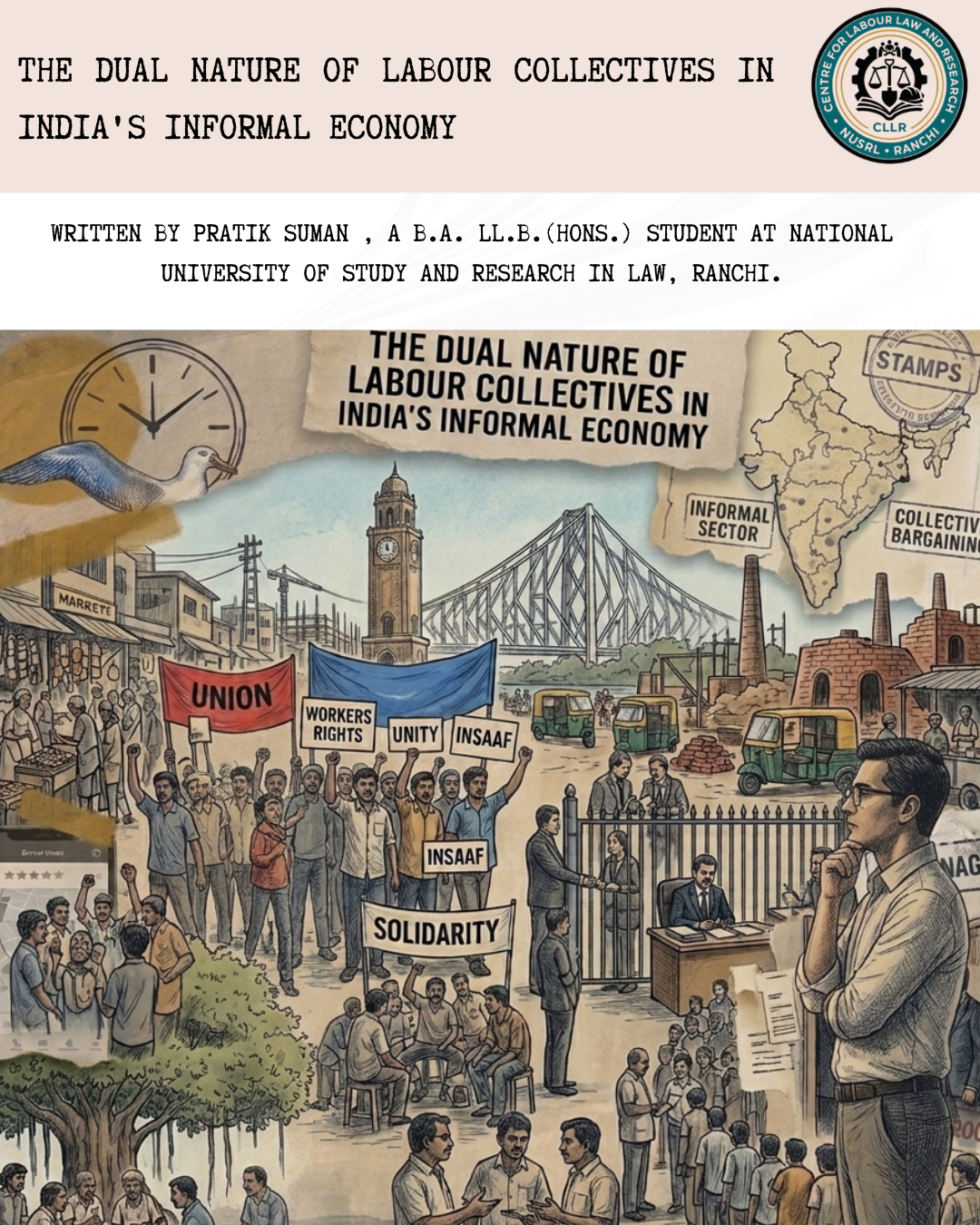
Written by Pratik Suman , a B.A. LL.B.(Hons.) student at National University Of Study and Research in Law, Ranchi.
I. The Price of Standing Still
One morning, on my way home from university, I asked my auto driver why he chose this job. Earlier in his career he had been a mason, the pay was irregular and wore his body down, so he took out a loan and bought an electric auto. He now earns close to ₹40,000 a month, before his instalment and running costs, and that income supports his wife and 3 year old daughter.
By any measure, this is a story of upward mobility. Yet when I asked what made the job hard, he did not mention traffic, fares or battery life. He spoke of the men at the chowks. At Argora, Kokar and Kanke, he said, groups without uniforms, receipts or any visible authority call themselves a “union” and collect money from every auto that stops. They give nothing in return. The police, he said, take their share. The traffic constables standing a few metres away do nothing.
This gives rise to a paradox of the protector. The labour collective exists, in theory, to shield the weakest worker from arbitrary power. On the chowk, it becomes an arbitrary power. Its demand is not backed by a statute, a contract or a vote of members. It is backed by the simple fact that the driver cannot work without stopping, and cannot stop without paying.
The thesis of this piece is narrow and testable. The word “union” does not by itself confer legitimacy on a collective that takes money from workers. What makes a collective legitimate is what the law already demands of every registered trade union and every public authority, voluntary membership, transparent accounts, elected leadership and a forum for complaint. A group that meets none of these is not a union in any sense the law recognises.
II. The Taxonomy of Collective Extraction
Treating every payment by a driver as “extortion” is as unhelpful as treating every collective as a “union”. The first lets genuine unions be painted as criminals. The second lets criminals borrow the moral authority of genuine unions. A three-level typology of payments separates the two.
Level 1: Membership Dues. The driver voluntarily joins a collective and pays a fixed subscription. In return he gets something identifiable: a welfare fund, legal help after an accident, representation before the transport office or the municipal corporation. Ranchi has examples. In February 2023, the Ranchi Zila Autochalak Union suspended services on five routes to protest illegal collection from drivers. In 2024, drivers struck against a new route chart imposed without their consultation. This is the collective doing what a union is for.
Level 2: Opaque Stand Fees. The payment is notionally lawful, a fee for using an auto stand, but its basis is unclear. Who fixed the amount? Who holds the contract? Where does the money go? During the 2023 dispute, one union leader alleged that collections at Argora Chowk, Ratu Road and elsewhere (₹20–25 per auto) ran under the patronage of the Ranchi Municipal Corporation. A rival union leader denied any illegality, calling them authorised stand fees, but conceded that stands were auctioned at inflated prices through union officials and that four auto unions themselves collect charges. Residents alleged that stand tax was collected even though stands lacked facilities. At this level, the payment may be legal, but it is not accountable. The picture has since become clearer.
Level 3: Coercive Gatekeeping. The payment has no legal basis at all. It is collected in cash, without a receipt, by persons who cannot show any authority, under an implied threat, pay, or you cannot stop here. In 2024, drivers complained that contractors collected “tokens” even where no stand existed, and used violence against those who refused. When the police are alleged to share in the proceeds, the driver has nowhere left to complain. In April 2026, the auto drivers’ association called a sit-in, alleging that the police themselves were collecting money illegally from auto and e-rickshaw drivers. Its demands included a single “global tender” so that fees are paid at one place, more permits, and an immediate end to illegal collection.
This typology is doctrinal, not merely descriptive. Level 1 is protected association, the core of Article 19(1)(c). The clause guarantees every citizen the right to form associations or unions, and the Supreme Court has read it to include the members’ right to choose whom they associate with. A driver who chooses to join a union, pays agreed dues and receives services in return is exercising exactly this freedom. The State may restrict it only on the limited grounds in Article 19(4), such as public order or morality. Level 2 is a regulatory failure, a fee lawful in form but unaccountable in substance, which calls for administrative reform. Level 3 is extortion wearing the mask of association, and it is here that the strongest case for intervention lies, whatever name the collectors give themselves.
III. Three Freedoms and the Private-Power Problem
Three fundamental rights converge at the chowk. Each must be read carefully, because each cuts in both directions.
Article 19(1)(c): the freedom of association. This is the right that protects a genuine union, and it is also the right a chowk levy violates. In Damyanti Naranga v. Union of India (1971), the Supreme Court held that the right to form an association includes the right of its members to continue associating only with those they voluntarily admit. Association, in the constitutional sense, rests on choice. A “union” that a driver never joined, never voted in and cannot leave, but must pay regardless, is the opposite of association. It is compulsion borrowing association’s vocabulary.
Article 19(1)(g): the freedom of trade and occupation. In Sodan Singh v. New Delhi Municipal Committee (1989), a Constitution Bench held that street trading is a legitimate occupation protected by Article 19(1)(g), and that the right to trade on public streets, if properly regulated, cannot be denied merely because streets are meant for passage. The Court also held that the right does not extend to occupying any spot of one’s choosing, and remains subject to reasonable restrictions under Article 19(6). The auto driver’s use of the chowk sits squarely within this framework. It may be restricted, but only by law, a municipal bye-law, a permit condition, a notified stand fee. A cash demand by unidentified men is not a restriction “imposed by law”. It is a private tax on fundamental freedom.
Article 21: the right to livelihood. Since Olga Tellis v. Bombay Municipal Corporation (1985), the right to life has been read to include the right to livelihood. For a driver repaying a vehicle loan, a daily levy is not a minor irritant. It is a direct deduction from the means of survival.
The private-power problem: The obvious objection is that Part III of the Constitution of India binds the “State” under Article 12, and a group of men at a chowk is not the State. Three answers meet this objection.
First, where the collection is made by contractors appointed by the municipal corporation, as drivers alleged in 2024, there is no private-power problem at all. A municipal contractor collecting a municipal fee exercises delegated State power, and must do so within the law that authorises the fee.
Second, in Kaushal Kishor v. State of Uttar Pradesh (2023), a Constitution Bench held by a 4:1 majority that rights under Articles 19 and 21 can be enforced even against persons other than the State or its instrumentalities. The majority also held that the State is under an affirmative duty to protect a person’s Article 21 rights even against threats from private actors. A purely private chowk racket is therefore no longer outside constitutional reach.
Third, where the police are alleged to share in the proceeds, private extortion becomes State facilitated deprivation. The constable who stands by is not a neutral bystander. He is the State, failing in precisely the affirmative duty Kaushal Kishor describes.
The statutory gap: The law that should fill this space does not quite reach it. The Code on Social Security, 2020 recognises self-employed workers as part of the unorganised workforce and builds a welfare architecture for them. The Industrial Relations Code, 2020 does bring self-employed unorganised workers within the meaning of “worker” for its trade union chapter, and defines a trade union to include combinations regulating relations between workers and workers. But, as a September 2026 analysis by a labour official points out, registration still requires a connection to an “industry”, which the Code defines through cooperation between an employer and workers. Whether a union of self-employed drivers with no employer can register therefore remains legally open . The Codes regulate the money that flows to him as welfare, but not the money that flows from him to those who claim to represent him. They speak to welfare, but not to power.
IV. The Doctrinal Spine: Regulation by Law, Not by Levy
The fundamental rights discussed above need a working body of law to give them effect at street level. Indian law already has three pieces of it. Read together, they form a spine for the argument.
First vertebra: the registered union as a model of accountability: Indian law has never treated a trade union as a mere gathering of people. Under the Industrial Relations Code, 2020, seven or more members may apply for registration, and a union must have at least ten per cent of the workers, or one hundred workers, whichever is less, as members. Registration carries obligations, written rules, a general fund, and, under the regulations framed since the Trade Unions Act, 1926, annual returns and audit of accounts. The point is not that every drivers’ collective must register. It is that the law has already decided what a body collecting money from workers in their name owes them, rules they can read, accounts they can inspect, and leaders they can replace. A group that refuses all three has no claim to the protection the law gives unions.
Second vertebra: the street as regulated public space: Sodan Singh did not end with a declaration of rights. A second judgment in 1992 directed the municipal bodies to examine hawkers’ claims and identify pavements where trading could be regulated without obstructing others. That logic, refined over two decades, became the Street Vendors (Protection of Livelihood and Regulation of Street Vending) Act, 2014. Its lesson for autos is direct. The answer to chaotic use of public space is not to abandon it to whoever controls it, but for the public authority to plan it, designated sites, transparent certificates and fees fixed by law.
Third vertebra: the criminal law of extortion and corruption: Section 308 of the Bharatiya Nyaya Sanhita, 2023 (formerly Sections 383–389 of the IPC) defines extortion as intentionally putting a person in fear of injury and thereby dishonestly inducing him to deliver property. A demand for cash, backed by the implied threat that the driver cannot stop, or by the actual violence drivers described in 2024, fits these ingredients regardless of the label the collectors use. On the other side, a police officer who accepts a share of the proceeds commits an offence under the Prevention of Corruption Act, 1988. And under the Supreme Court’s 2006 directions in Prakash Singh v. Union of India, district-level Police Complaints Authorities were to be set up to inquire into complaints against officers up to the rank of Deputy Superintendent, including allegations of extortion.
Why is the spine not enough on its own?: Each vertebra exists, but none is designed for the chowk. Union law assumes an employer. Street vending law covers hawkers, not drivers. Criminal law depends on a complaint, and the driver who must complain is the one with the most to lose, he cannot afford a day off the road, he may not hold a valid permit, and the officer receiving his complaint may be the one he is complaining about. The failure here is not a lack of law. It is a lack of a forum the worker can safely reach. Like the absence of a hearing in an automated system, the absence of a safe complaint route is not incidental. It is what keeps the levy running, and it must be fixed by design, not left to interpretation.
V. The Comparative Picture: What Others Have Tried
The problem of collectives that protect and prey at the same time is not unique to Ranchi. Three models, one foreign and two Indian, show both what works and what can go wrong.
Kenya: mandatory SACCOs for matatus. Kenya’s minibus taxis, the matatus, operated for decades as an atomised, loosely regulated sector. In 2010 the government directed that every matatu owner must join a Savings and Credit Cooperative Organisation (SACCO) or a transport company as a condition of renewing their operating licence, with a deadline of 31 December 2010. The aim was to replace individual chaos with accountable, registered collectives. The results are instructive in both directions. Researchers found that SACCOs provided dividends and member services that reduced members’ exposure to risk. But the sector’s cartels did not disappear. Terminal-controlling gangs and route “protectors” continued to extort operators, with one newspaper investigation estimating losses of around KSh47 billion a year. Some SACCOs themselves became toll gates, one Kenyan report described joining fees of Sh30,000–60,000 paid with no receipt and no questions allowed.
The lesson is precise. Mandating membership of a collective, without mandating its transparency, simply gives the extortionist a registration certificate. Formalisation is necessary but not sufficient.
India: Town Vending Committees under the Street Vendors Act, 2014. This is the closest domestic model for governing workers who earn a living on public streets. Each local authority must constitute a Town Vending Committee, on which street vendor representatives, elected by vendors themselves, make up 40 per cent of the members, with a third of those reserved for women, and NGOs and community organisations another 10 per cent. The committee surveys vendors, issues certificates and helps plan vending zones. The design matters more than the results so far. Implementation has been uneven, and civil society reviews have found many committees not functioning. But the model answers the question the chowk raises, who decides where a worker may stand and what he pays? Under the Act, the worker has an elected seat at that table.
India: SEWA and the union without an employer: The Self-Employed Women’s Association, founded in Ahmedabad in 1972, organised vendors, home-based workers and labourers who, like the auto driver, had no employer. Its founders famously had to argue that a union of workers does not need an employer to exist. SEWA shows that a collective of self-employed workers can be democratic, membership-based and accountable to the people it represents.
These three models lead to the same conclusion. The question is not whether informal workers should be organised. It is what conditions the law attaches to any body that claims to organise them.
VI. An Accountability Floor for Informal Collectives
The aim is not to abolish unions at the chowk or to criminalise every payment a driver makes. Genuine collectives, Level 1 in the taxonomy, deserve protection. What is needed is a floor, a minimum set of guarantees that any body must meet before it can collect money from informal workers, and that the State must meet before it can charge for public space.
First pillar: no receipt, no payment. Every payment demanded from a driver at a stand or chowk must be backed by an identifiable authority and a receipt. Municipal stand fees should be fixed by notification, displayed at the stand, and collected only through digital or receipted channels. A cash demand without a receipt should be presumed unauthorised and treated as extortion. This responds directly to the Level 2 problem of opaque fees, and strips Level 3 collectors of the ambiguity they rely on.
Second pillar: an Auto Stand Committee modelled on the Town Vending Committee. Ranchi, and cities like it, should constitute a committee with elected driver representatives (on the 40 per cent model of the Street Vendors Act), alongside the municipal corporation, traffic police and the transport office. It would plan the number and location of stands, fix and publish fees, decide how stand contracts are awarded, and review whether permits match the vehicles actually on the road. The 2023 allegation that stands were auctioned at inflated prices through union officials is exactly the kind of question such a committee should answer in public.
Third pillar: a complaint route that bypasses the chowk. Drivers need a time-bound complaint channel that does not begin at the police station whose officers may be implicated. This could be a helpline or portal run by the district administration, with a duty to act within a fixed period, and escalation of complaints against police to the district Police Complaints Authority envisaged in Prakash Singh. Complaints should be accepted anonymously, since the driver bears the risk of retaliation.
Alongside these pillars, a simple disclosure rule would separate real unions from fronts, any body that collects money from drivers in the name of representing them should be required to display its registration, its office bearers and its annual accounts. Genuine unions already meet this standard. Only those who should not be collecting at all would object.
None of these measures restricts the freedom of association. They protect it, by making sure that the word “union” means what Article 19(1)(c) protects, and not what the chowk has made of it.
Conclusion
The driver who took me home did everything right. He changed his work, took a risk on a loan, and built a stable income for his family. The collective at the chowk added nothing to that story except a cost. Yet the answer is not to distrust collectives. The same city has seen drivers strike against exactly this kind of extortion.
What the Constitution requires before a worker’s earnings can be taken does not depend on what the taker calls himself. A tax requires a law. A fee requires an authority and a receipt. A union requires members who chose it and leaders they can remove. If Indian labour law is to remain coherent in its informal economy, it must extend a settled principle, running from Sodan Singh to Kaushal Kishor, to a space the drafters never had in mind, the chowk. A union may speak for the worker, but it cannot own the street he works on.
Caveat: The views, analyses, and information presented in this article are provided in good faith and for general informational purposes only. No representation or warranty, express or implied, is made regarding the accuracy, adequacy, validity, reliability, or completeness of the information. Readers should conduct their own research and seek professional guidance where appropriate. Neither the author nor the publisher shall be held responsible for any loss, liability, or consequence arising from reliance on this content.
Leave a Reply